Save Our wild Salmon
  • About
      • Back
      • Save Our Wild Salmon
      • The Coalition
      • Board of Directors
      • SOS Team
      • NextGen Salmon Collective Team
      • Factsheets & Reports
      • Business Partners
      • Career Opportunities
  • Projects
      • Back
      • Restoring the Lower Snake River
      • Tackling the Climate Challenge
      • Protecting Orca by Restoring Salmon
      • Modernizing the Columbia River Treaty
      • Hot Water Reports
  • News & Media
      • Back
      • News
      • Opinion
      • SOS Blog
      • Press Releases
      • Newsletters
      • Videos
  • Get Involved
      • Back
      • Take Action
      • Volunteer With Us
      • Events
      • Stay Connected
  • Support Us
      • Back
      • Donate Online
      • More Ways to Give
      • Planned Giving
  • Shop
DONATE
DONATE

Hot Water Report 2025: Issue 6

Hot Water Report web banner 1200 400
INTRODUCTION: 

The 2025 Hot Water Report provides real-time data in the lower Snake and Columbia river reservoirs to detail the collective impacts of hot, stagnant, and toxic waters on already-imperiled salmon and steelhead. 

EXECUTIVE SUMMARY:

  1. Hot water temperatures in the lower Snake and Columbia rivers: Many of the reservoirs behind the lower Snake and Columbia River dams have experienced more than 80 days of water temperatures exceeding the 68°F “harm threshold” set to protect migrating salmon and steelhead. 
    • Highest water temperature in the lower Snake River: On August 17, Ice Harbor Dam’s reservoir registered the highest water temperature of 72.95°F – nearly 5°F above the 68°F “harm” threshold.
    • Total days above 68°F in the lower Snake River: Ice Harbor reservoir has been above 68°F for the longest at 89 consecutive days. 
    • Read current water temperatures in the lower Columbia and Snake rivers here. 
  2. Toxic water in the lower Snake River: For the third consecutive year, toxic algal blooms with microcystins (a liver toxin) have been detected in the lower Snake River. Toxic algal bloom health advisories remain in effect today.
  3. On the brink of extinction: The status of salmon, steelhead, and Southern Resident orcas: Despite billions of dollars and decades of efforts to restore Southern Residents and salmon, they both teeter on the brink of extinction today:
    • Status of Salmon and Steelhead: Idaho Rivers United recently published their Wild Salmon and Steelhead Returns Report, including adult Spring/Summer Chinook, Steelhead, and Sockeye returns as of 9/15/25. The report shows Snake River salmon and steelhead return annually far below the recovery goals necessary to remove them from the protections of the Endangered Species Act and to achieve region-wide goals.
    • Status of Southern Resident Orcas: Southern Resident orcas, listed as endangered in both the U.S. and Canada, have only 74 individuals surviving (according to the Center for Whale Research’s annual census of the Southern Resident population completed in July 2025). The recent tragic deaths of several orcas underscore the continuing need for abundant salmon throughout the range of the Southern Residents and on a year-round basis. Restoring abundant salmon populations in the Snake River Basin is an essential ingredient for successful recovery.

WATER TEMPERATURE DATA FOR LOWER SNAKE AND COLUMBIA RIVERS

Introduction to the water temperature data: The daily average and high water temperature data at the eight reservoir forebays are measured with sensors stationed at various depths below the reservoir surface, immediately upstream from the dams.

LOWER SNAKE RIVER WATER TEMPERATURE DATA 

Click here to view the lower Snake River water temperatures - 2025 Daily Average and 10-year Average.

Average water temperature:  Between July 1 - September 29, the highest daily average temperature across all four lower Snake reservoirs was at Ice Harbor reservoir, averaging 72.64°F on August 17.

Highest water temperature: On August 17, Ice Harbor Dam’s reservoir registered the highest water temperature of 72.95°F – nearly 5°F above the 68°F “harm” threshold.

Total days above 68°F in the lower Snake River: Ice Harbor reservoir has been above 68°F for the longest at 89 consecutive days.

LOWER COLUMBIA RIVER WATER TEMPERATURE DATA 

Click here to view the lower Columbia River water temperatures - 2025 Daily Average and 10-year Average.

Average water temperature: Between July 1 - September 29, John Day reservoir had the highest daily average temperature at 73.76°F on September 6.

Highest water temperature: On August 28, the John Day reservoir registered the highest water temperature of 74.48°F – over 6 degrees above the 68°F “harm” threshold.

Hot Water Temperatures and Toxic Algal Blooms in the Lower Snake River

Today, Snake River salmon and steelhead face dramatically decreased survival rates, largely due to the federal system of dams and reservoirs in the Columbia River Basin. The dams on the lower Snake River in southeast Washington State—Ice Harbor, Lower Monumental, Little Goose, and Lower Granite—and their stagnant reservoirs heat up this historic, once highly productive river, harming and killing both juvenile and adult fish.

How do the dams impact water temperatures? The lower Snake River dams create stagnant reservoirs - large, slow-moving pools that absorb enormous amounts of solar radiation and cause water temperature to reach lethally high levels. The reservoirs warm during the summer months and create a block (barrier) of hot slow-moving water that retains the heat through the night and does not cool until air temperatures remain low in the fall. Fish ladders, the only route past the dams for adult fish, also frequently contain warm surface waters that are hotter than the average river temperature, and such conditions create and exacerbate migration blockages. These blockages prevent successful migration to spawning grounds and attract predators, thereby reducing the survival and reproduction of salmon.

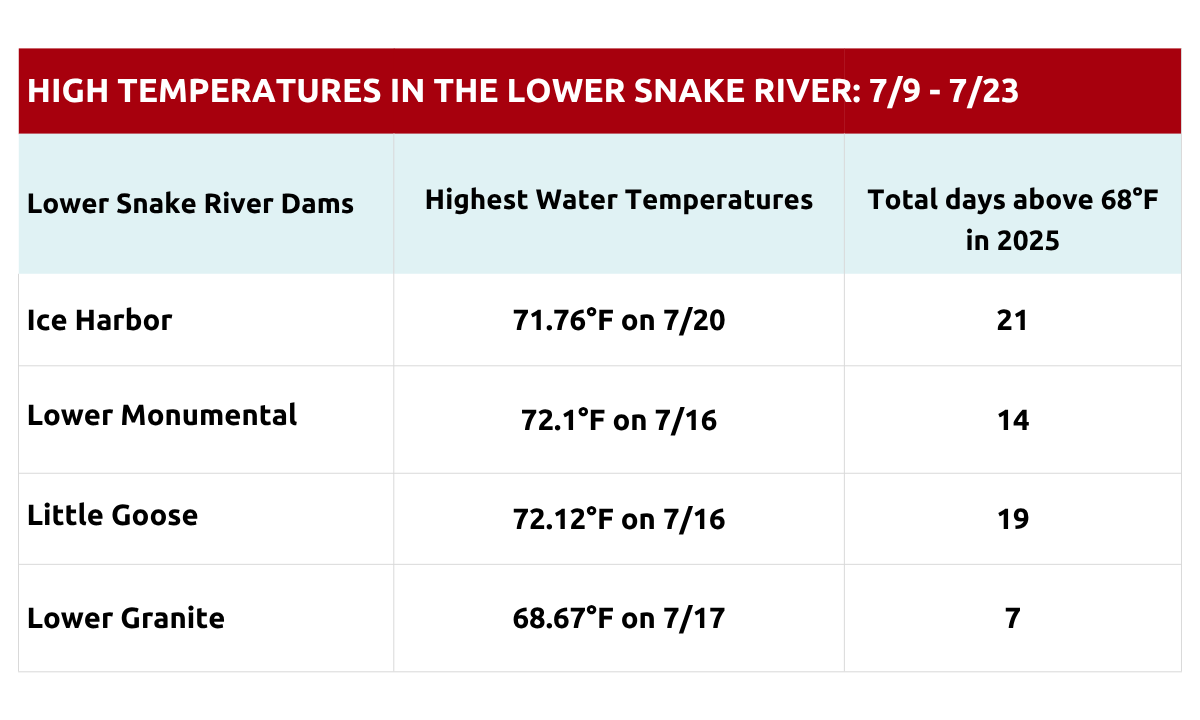
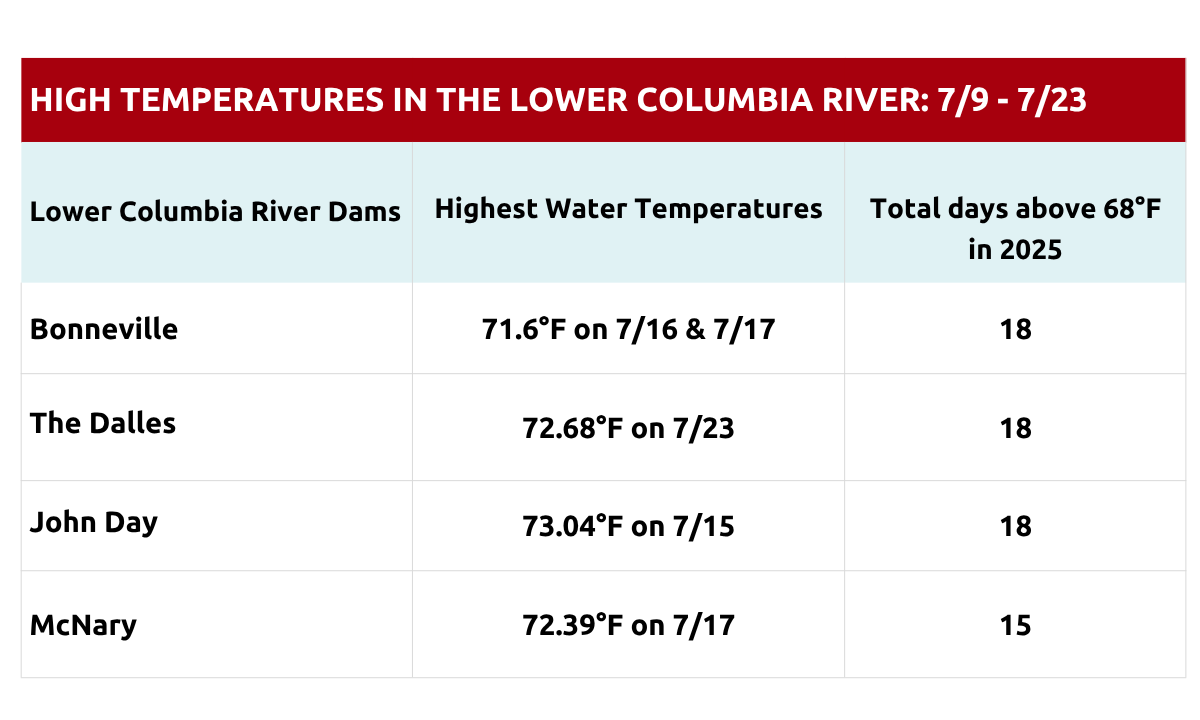
High Water Temperatures in 2025: All lower Columbia and Snake River dams and their reservoirs have reached water temperatures above 68°F – above the biological and legal threshold scientists identified to protect salmon from lethal water temperatures. Endangered Snake River fish migrate through a total of eight dangerously hot and stagnant reservoirs on their migration to the ocean as juveniles and again on their journey back upstream as adults. Depending on salmon species, migration for salmon and steelhead stops altogether when water temperatures reach 72-73°F. Salmon that have stopped or slowed their migration can languish for days or weeks in warm water and die from thermal stress and disease.

Salmon and steelhead are highly resilient. They can tolerate episodes of warm water, but they have limits on how long and how much hot water they can withstand. The cumulative impact of hot reservoirs in the lower Columbia and the lower Snake must be addressed quickly - to reduce water temperatures and the overall exposure time for these fish to waters above 68°F.

Emergency fishing closures: The warming water temperatures that occurred this fall in the Columbia and Snake rivers impacted the behavior and survival of fall Chinook and steelhead by significantly delaying their migration into Idaho. As a result of warming waters slowing fall Chinook migration and causing a reduction in the number of fish reaching northeast Oregon and Idaho, adult fall Chinook salmon fisheries in the Snake River were closed from Sept. 19 to Oct.4.

Toxic algal blooms: For the third consecutive year, toxic algal blooms with microcystins have been detected in the lower Snake River. Microcystin is a liver toxin that can pose a significant health risk if ingested, inhaled, or upon skin contact. The warm and stagnant water conditions created by the dams allow toxic algal blooms to grow, making the river sick, unsafe, and dangerous for people, pets, and already endangered salmon and steelhead. Already under stress due to warm reservoir temperatures, salmon and steelhead must also migrate through toxic algal blooms that can cause oxygen depletion and changes in pH levels. 

Below are confirmed toxic algal blooms present in the lower Snake River and Snake River region (as of October 6, 2025): 

Toxic algal bloom Oct 2025

TOXIC ALGAL BLOOMS IN THE LOWER SNAKE RIVER

  • Ice Harbor 
  • Rice Bar (Snake River)
  • Nisqually John Landing
  • Wawawai Landing
  • Grainte Point
  • Charbonneau Park
  • Central Ferry Boat Dock - On October 7, 2025, Garfield County Public Health issued a toxic algal bloom warning. Testing is being processed, and residents are advised to use caution. The toxic algal bloom has been spotted on the Snake River at the Central Ferry Boat Dock. 

TOXIC ALGAL BLOOMS IN THE SNAKE RIVER (between Oregon and Idaho):

  • Brownlee and Hells Canyon Reservoir
  • Eagle Bar (Hells Canyon)

ON THE BRINK OF EXTINCTION: THE STATUS OF SALMON, STEELHEAD, AND SOUTHERN RESIDENTS

Status of Snake River salmon and steelhead:

Wild Salmon and Steelhead Returns Report by Idaho Rivers United 
Click here to view the full report.

Sources: Fish Passage Center, Idaho Department of Fish and Game, and the Columbia Basin Partnership (CBP)

The Wild Salmon and Steelhead Returns Report by Idaho Rivers United shares returns as of 9/15/25:

  • Historical returns: The report includes historic Snake River salmon and steelhead population numbers as a critical reminder that the Snake Basin once supported millions of returning salmon and steelhead, and how diminished current numbers are today, as seen in the graphs outlining yearly returns.
  • Yearly returns: The graphs show annual return numbers for various runs of Snake River fish, some of which are currently in-season. They also give important context with population estimates immediately pre-lower Snake River Dams. These populations from the mid-20th century represented abundant, harvestable numbers of wild fish, and recovery to these levels is possible in the future thanks to the high-quality habitat upstream from the dams.
  • Current returns: Snake River sockeye are listed as “endangered” – the most severely imperiled ESA status. As of 9/15/25, just 14 wild/natural sockeye salmon have returned to the Stanley Basin in Central Idaho.
  • Quasi-extinction threshold: “Salmon runs have plummeted since the signing of the treaties and reservation executive orders that would protect the Tribes’ harvest rights.[...] wild-origin returns of salmon to the Snake Basin are 0.1-2% of their historical abundance, with many populations at or below a quasi-extinction threshold,” states the Department of Interior’s Historic and Ongoing Impacts of Federal Dams on the Columbia River Basin Tribes Analysis. A quasi-extinction threshold (QET) signifies 50 spawners or less in a salmon or steelhead sub-population, and is a sign of near-term extinction. After the QET threshold is passed, the probability of recovery is low without substantial and immediate intervention.
  • Recovery Goals: Snake Basin recovery goals were developed by fisheries managers and stakeholders in the Columbia Basin Partnership Phase II Report, and represent healthy and harvestable levels of abundance. The goals displayed on the graphs above are for populations returning to currently accessible habitat. Snake River salmon and steelhead populations are currently far below these high-end recovery targets, as well as the thresholds necessary for ESA delisting.

Status of Southern Residents: 

Southern Residents are the original fishers of the Pacific Northwest waters, co-evolving over millennia with their preferred prey, Chinook salmon. However, Southern Resident orcas are listed as endangered in both the U.S. and Canada, with only 74 individual Southern Resident orcas surviving (according to the Center for Whale Research’s annual census of the Southern Resident population completed in July 2025).

There have been many losses of Southern Resident calves and the outward grief that the Southern residents express:

On December 31st, 2024, 27-year-old J35 Tahlequah was seen carrying a dead female neonate calf in the Salish Sea. She continued to carry the calf for several more days, reminiscent of her 17-day Tour of Grief in 2018.

On September 12th, 2025, 26-year-old J36 Alki was documented by the Center for Whale Research carrying a dead female neonate calf with its umbilical cord still attached. This was not her first loss. Alki’s 2-year-old son J52 Sonic died in 2017, and she has experienced multiple miscarriages since then.

Less than a week later, a brand-new calf was spotted in the J16 matriline. Alki’s sister, 18-year-old J42 Echo, is the presumed mother, which was certainly welcome of bittersweet news. Meanwhile, J62 and J63, born last winter, appear to be doing well.

Columbia-Snake River Basin salmon importance to Southern Resident orcas:

We cannot know for certain the exact cause of death of these two calves, while others born to J Pod in the past year have survived. But we do know that the persistent lack of salmon on a year-round basis is the single greatest threat to Southern Residents' survival. Snake River Spring/Summer Chinook and Snake River Fall Chinook as well as many Columbia-Basin salmon runs are ranked in the top 10 Priority Chinook stocks for orca recovery. The Southern Residents are experiencing a very high rate of miscarriage, primarily due to low availability of salmon.

Despite billions of dollars and decades of efforts to protect and restore Southern Residents and salmon, they both teeter on the brink of extinction today. Both the successful births and tragic deaths underscore the urgent need for abundant salmon throughout the range of the Southern Residents on a year-round basis. Restoring healthy salmon populations in the Snake River is an essential component for successful recovery.

Learn more about the status of Southern Resident orcas and the latest research on recovering endangered Southern Residents informed by Bigg’s orcas' recovery journey, from the research of Orca Behavior Institute with reports from Pacific Whale Watch Association, and Orca Network.

Read more about Center for Whale Research’s annual census of the Southern Resident population here and on the recent Seattle Times article, "Southern resident K pod falls to lowest number since counts began."

Recovering Healthy, Abundant, and Harvestable Salmon and Steelhead Populations: 

Endangered sockeye salmon in Redfish Lake - 900 miles inland and 6500 feet above sea level. © Emily Nuchols

The Snake and Columbia River Basins contain some of the very best available habitat for salmon populations to recover to any significant level of abundance. We can recover healthy and abundant salmon populations, restore resilient rivers and streams that these fish depend upon in the Columbia-Snake Basin, and ensure a more prosperous future for all people and communities. As Jeremy Takala, Chair, Columbia River Inter-Tribal Fish Commission, states, “We must restore Columbia Basin fisheries to healthy and abundant levels. The economic and ecological health of our region requires it, and tribal treaty rights demand it.”

With this continuing crisis in the lower Snake River, and many Columbia-Snake River salmon and steelhead populations facing extinction, the “Six Sovereigns” — Confederated Tribes of the Umatilla Indian Reservation, Confederated Tribes of the Warm Springs Reservation of Oregon, the Confederated Tribes and Bands of the Yakama Nation, Nez Perce Tribe, State of Oregon, and State of Washington — jointly developed in 2023 the Columbia Basin Restoration Initiative (CBRI). It is a comprehensive, science-based, and durable strategy to restore salmon and other native fish populations to healthy and abundant levels, ensure a clean energy future, support local and regional economic and climate resilience, restore ecosystem function, and honor longstanding unmet commitments to Tribal Nations.

Restoring a free-flowing lower Snake River is one essential strategy to provide a critical cold-water refuge that salmon and steelhead have historically relied upon to rest and recover during their long upstream migration. It can also dramatically reduce the incidence of toxic algal blooms. Restoring a free-flowing river has proven to benefit the ecosystem, fish, and people. NewsData recently focused attention on the Klamath River’s first year as a free-flowing river. It found that scientists are already seeing dramatic changes in average daily water temperatures in the stretch of river. “We’re just opening up that river to be free-flowing, and basically just allowing it to do its normal hydrological things: scour the river, help with fish disease, help with the temperature aspect and get rid of blue-green algae,” said Crystal Robinson, Klamath Watershed program manager for the California Department of Fish and Wildlife.

Salmon and steelhead—and endangered Southern Resident orcas and other fish and wildlife that depend on salmon—are running out of time. At this moment, we have an urgent need to restore ecosystem health, improve resilience and recover salmon and steelhead by removing the four lower Snake River dams and replacing the dams’ services. By protecting the Northwest's native fish from extinction, we will help to uphold our nation's promises to Treaty Tribes and reconnect this emblematic fish to 5,500 miles of pristine, protected river and streams in Idaho, Oregon, and Washington. This is our greatest river/salmon restoration opportunity anywhere on the West Coast.

FURTHER INFORMATION: 

  • Earthjustice: Columbia Basin Salmon in Peril
  • Idaho Capital Sun article series by Pat Ford highlighting recent science from and urgent action by the Nez Perce Tribe, Confederated Tribes of the Umatilla Indian Reservation, Oregon Department of Fish and Wildlife, and committed community leaders to prevent salmon extinction and protect salmon endangered by deeply degraded river and stream habitat:
    • Salmon extinction in motion in Washington’s and Oregon’s Snake River
    • Salmon and steelhead extinction threshold science, and the ocean fish of northeast Oregon
    • The good work underway by Pacific Northwest salmon people in northeast Oregon
    • Last thoughts on salmon and steelhead extinction in the Pacific Northwest
  • Idaho Conservation League: Our “Normal” Salmon and Steelhead Population Isn’t What it Used to Be, and Orca Mothers, Salmon, and the Fight for Survival
  • Idaho Statesman: Opinion: Snake River salmon lawsuits were on hold. Now we have to resume
  • The Oregonian: Opinion: Back to court, but our regional work to protect salmon will continue

LEARN MORE FROM HOT WATER REPORT PARTNERS:

  • Association of Northwest Steelheaders
  • Columbia Riverkeeper
  • Idaho Conservation League
  • Idaho Rivers United
  • National Wildlife Federation
  • Nimíipuu Protecting the Environment
  • Northwest Sportfishing Industry Association
  • Orca Network
  • Sierra Club Washington State Chapter
  • Snake River Waterkeeper

READ PAST ISSUES OF THE HOT WATER REPORT


Data Sources: The 2025 water temperature data for the lower Snake River and lower Columbia River presented in the Hot Water Report are collected from the USGS, and the Columbia River DART program by Columbia Basin Research, University of Washington, with data courtesy of the U.S. Army Corps of Engineers (USACE). These data temperatures are provisional. The 10-year average water temperature data is courtesy of the Fish Passage Center. There is no data available for the Lower Monumental 10-year average water temperature. Graphs and tables are assembled by SOS Staff.

Hot Water Report 2025: Issue 5

Hot Water Report web banner 1200 400
INTRODUCTION: 

The Hot Water Report provides real-time data in the lower Snake and Columbia river reservoirs to detail the collective impacts of hot, stagnant, and toxic waters on already-imperiled salmon and steelhead. This year’s report focuses on bringing the data to life, featuring stories from scientists, Tribes, and community members regarding the challenges our Northwest native fish face, and the opportunities to heal their rivers and the ecosystem.

EXECUTIVE SUMMARY:

  1. Hot water temperatures in the lower Snake and Columbia rivers: Many of the reservoirs behind the lower Snake and Columbia River dams have experienced more than 70 days of water temperatures exceeding the 68°F “harm threshold” set to protect migrating salmon and steelhead. 
    • Highest water temperature in the lower Snake River: Lower Granite Dam’s reservoir registered the highest water temperature of 71.73°F on September 7.
    • Total days above 68°F: Ice Harbor reservoir has been above 68°F for 74 consecutive days.
    • Read current water temperatures in the lower Columbia and Snake rivers here. 
  2. Toxic water in the lower Snake River: Water in the lower Snake River continues to test positive for microcystins, a toxin that harms the liver and is commonly responsible for human and animal poisonings, and habitat degradation. On September 4, Whitman County Public Health issued another Health Advisory after a water sample tested positive for microcystins at Wawawai Landing in the Lower Granite Dam’s reservoir. The toxic algal blooms have grown over the course of this summer and are located today intermittently between the Little Goose Dam and Lower Granite Dam.
  3. Benefits of a free-flowing lower Snake River: We have a once-in-a-lifetime opportunity to lead the largest salmon and river restoration in history, bolster the Northwest economy, and modernize our infrastructure and replace the services of the lower Snake River dams for a more resilient future. In this issue of the Hot Water Report, we’ll focus on the importance of salmon recovery and the opportunity that restoration of the lower Snake River represents to expand the recreation economy, and how the benefits of service replacement can better serve the needs of communities, ratepayers, and businesses throughout the Columbia-Snake River Basin and Pacific Northwest region.

WATER TEMPERATURE DATA FOR LOWER SNAKE AND COLUMBIA RIVERS

Introduction to the water temperature data:

  • The Hot Water Report provides bi-weekly updates on real-time water temperatures in the lower Snake and Columbia River reservoirs. We track water temperatures in all eight reservoirs in the lower Snake and Columbia rivers to understand the river conditions that salmon and steelhead must migrate through.
  • The daily average and high water temperature data at the eight reservoir forebays are measured with sensors stationed at various depths below the reservoir surface, immediately upstream from the dams.

LOWER SNAKE RIVER WATER TEMPERATURE DATA 8/29 - 9/14

Click here to view the lower Snake River water temperatures - 2025 Daily Average and 10-year Average.

Average water temperature: Between August 29 - September 14, the highest daily average temperature across all four lower Snake reservoirs was at Ice Harbor reservoir, averaging 71.47°F. 

High Temps LSR 9 14

Highest water temperature: Lower Granite Dam’s reservoir registered the highest water temperature of 71.73°F on September 7.

Total days above 68°F in the lower Snake River: Ice Harbor reservoir has been above 68°F for 74 consecutive days.

LOWER COLUMBIA RIVER WATER TEMPERATURE DATA 8/29 - 9/14

LCR Sept 14Click here to view the lower Columbia River water temperatures - 2025 Daily Average and 10-year Average.

Average water temperature: Between August 29 - September 14, John Day reservoir had the highest daily average temperature at 73.76°F.

High temps LCR 9 14

Highest water temperature: The John Day reservoir registered the highest water temperature of 74.30°F on 9/6.

DISCUSSION OF DATA: 

Many of the reservoirs behind the lower Snake and Columbia River dams have experienced over 70 days of water temperatures exceeding the 68°F “harm threshold” set to protect migrating salmon and steelhead. All lower Columbia and Snake river reservoirs have reached temperatures of at least 70°F - 72°F, with temperatures as high as 73°F - 74°F in the lower Columbia River. The dams and their reservoirs are heating much of this river system, making it difficult and/or impossible for adult salmon and steelhead to safely migrate to their spawning grounds, and for summer-migrating juvenile fish to reach the ocean.

Salmon and steelhead are highly resilient. They can tolerate episodes of warm water, but they also have limits on how long and how much hot water they can withstand. The cumulative impact of hot reservoirs in the lower Columbia and the lower Snake must be addressed quickly - to reduce water temperatures and the overall exposure time for these fish to waters above 68°F.

In a recent Lewiston Tribune article, Joe DuPont, regional fisheries manager for the Idaho Department of Fish and Game, stated steelhead and fall chinook appear to be waiting for water to cool in the Snake River before moving further upstream. Fish are passing dams on both the Columbia and Snake rivers, but some fish appear to be reluctant to enter the Snake. “Once it cools down, we think there will be a pulse of fish coming [to Idaho],” DuPont states.

An effective collaboration between the Northwest states, the federal agencies, and Tribal Nations is urgently needed to address rising water temperatures across the basin. Restoring a free-flowing lower Snake River is one essential piece of this puzzle. It will provide a critical cold-water refuge that salmon and steelhead have historically relied upon to rest and recover during their long upstream migration. A freely-flowing river - rather than stagnant reservoirs - will remain much cooler through the summer, especially with cold water infusions released from the Dworshak Reservoir upstream on a tributary to the Clearwater River near Lewiston, ID. With a restored lower Snake River, its significantly cooler waters will extend 140 miles downstream - from the town of Lewiston to its confluence with the Columbia River in south-central Washington State near the Tri-Cities.


Toxic water in the lower Snake River

Toxi Algal Blooms LSR Snake River 2025 Scott PutnamLeft photo: Lower Snake River aquatic fish in toxic algal blooms near Clarkston, WA. Right photo: Toxic algal blooms in the lower Snake River near Lower Granite Dam. © Scott Putnam / Bluz River Production, 2025

The lower Snake River continues to test positive for microcystins, a toxin that harms the liver and is commonly responsible for human and animal poisonings, and habitat degradation.

On September 4, Whitman County Public Health issued another Health Advisory after a water sample tested positive for microcystins at Wawawai Landing in the Lower Granite Dam’s reservoir. The toxic algal blooms can be found intermittently today between the Little Goose Dam and Lower Granite Dam.

Below are confirmed toxic algal blooms present in the lower Snake River and Snake River region and health advisories:

TABs Snake River Sept15

TOXIC ALGAL BLOOMS IN THE LOWER SNAKE RIVER

Lower Granite Reservoir (at or near):

  • Nisqually John Landing - Whitman County Public Health’s Advisory (water sample taken on 8/18/25)
  • Rice Bar (Snake River) - Garfield County Public Health’s Advisory (water sample taken on 8/26/25)
  • Wawawai Landing - Whitman County Public Health’s Algal Bloom webpage (water samples taken on 9/2/25 and 9/8/25)

TOXIC ALGAL BLOOMS NEAR THE CONFLUENCE BETWEEN LOWER COLUMBIA AND SNAKE RIVERS

McNary National Wildlife Refuge:

  • McNary Slough - Walla Walla County Department of Community Health (water sample taken on 8/25/25)
  • McNary Slough - Walla Walla County Department of Community Health (water sample taken on 9/2/25)
  • Casey Pond - Walla Walla County Department of Community Health (water sample taken on 9/2/25)

TOXIC ALGAL BLOOMS IN THE SNAKE RIVER

Snake River (between Oregon and Idaho):

  • Brownlee and Hells Canyon Reservoir - Idaho Department of Health & Welfare (water sample taken on 7/23/25)
  • Eagle Bar (Hells Canyon) - Idaho Department of Health & Welfare (water sample taken on 8/14/25) 

Restoring a free-flowing lower Snake River to benefit the ecosystem, wildlife, communities, and economy 

We have a once-in-a-lifetime opportunity to lead the largest salmon and river restoration in history, bolster the Northwest economy, and modernize our infrastructure by replacing the services of the lower Snake River dams. With strong political leadership and strategic investments, we can restore a free-flowing lower Snake River, recover salmon, steelhead, and orca populations, uphold our nation’s commitments to Northwest Tribes, and affordably, efficiently, and urgently replace the services currently provided by the four lower Snake River dams.

In the remainder of this issue of the Hot Water Report, we’ll cover the importance of salmon recovery and how the restoration of the lower Snake River would support the recreation economy, and the benefits of service replacement would better serve the needs of communities, ratepayers, and businesses throughout the Columbia and Snake River Basin.

RECREATION OPPORTUNITIES IN A RESTORED LOWER SNAKE RIVER:

  • Restoring the lower Snake River to recover salmon, habitat, and provide a safer river to enjoy: The lower Snake River dams and their reservoirs have transformed a healthy, living river into stagnant, hot water reservoirs, creating conditions where toxic algal blooms are now a yearly occurrence. The lower Snake River is becoming a hazardous place for wildlife, pets, and people to enjoy and connect with this historic river. A restored river would recover 140 miles of river, re-create salmon spawning habitat, lower water temperatures, dramatically reduce the incidence of toxic algal blooms, and support a healthier Snake River overall – one that benefits fish, people, communities, watersheds, and cultures.
    • Restoring habitat for native fish, plants, and wildlife, and for people to recreate: A healthy Snake River and abundant salmon will provide new habitat for native fish, plants, and wildlife. A flourishing ecosystem will bring and support a vibrant outdoor economy, drawing hunters, anglers, birdwatchers, and other wildlife viewers from the Northwest and beyond. A free-flowing and clean river will bring new opportunities to camp in the lower Snake River, explore over 60 named rapids, and enjoy activities such as whitewater rafting, canoeing, and kayaking. This has the potential to support the only multi-day river adventure in Washington State.
    • Recovering historical and cultural areas in the lower Snake River: People have lived in the lower Snake River region for more than 12,000 years, and restoring the free-flowing river would uncover Indigenous villages, burial grounds and archaeological sites, as well as recreation areas and important wildlife habitat that have been flooded by the dams and their reservoirs. The Snake River is central to four National Park Service units, including the Lewis & Clark National Historic Trail and Nez Perce National Historic Park. With a restored river, these park units will create avenues to highlight protected and important Indigenous cultural sites, additional storytelling, and enhanced recreation. 
  • Columbia Basin recreational salmon & steelhead fishing fuels the Northwest economy: The four lower Snake River dams and their reservoirs have helped decimate salmon and steelhead runs, causing emergency fishing closures and reduced fishing opportunity on the Columbia and Snake Rivers and their tributaries. These closures have had significant impacts on the sport and Tribal fisheries—threatening many businesses and Tribal communities’ ways of life. When emergency fishing closures can occur at a moment's notice, it makes it more difficult for businesses to book clients to fish and reserve flights and hotels. Just earlier this week, fisheries officials raised the possibility of having to increase regulations for fall chinook due to “exceptionally high” river temperatures slowing the run.
    • Columbia Basin sportfishing industry consists largely of small, often family-run businesses, produces around $3 billion in economic development annually, and acts as a reliable transfer of wealth from urban to rural areas.
    • Fishing licenses in the Columbia Basin: There are more than half a million people who have purchased a license to be able to fish for salmon and steelhead in the Columbia Basin.
    • Recreational anglers made 539,214 trips for salmon and steelhead in 2022 on the mainstem Columbia and Snake Rivers, from the mouth into Idaho. This fishing activity pumped $49.6 million into the Northwest’s economy.
    • Healthy and harvestable salmon provide stability for fishing businesses and tourism: If salmon and steelhead populations were restored to healthy, harvestable abundance, the Northwest Sportfishing Industry Association anticipates angler trip values in the mainstem and into Idaho could grow to $124 million or more annually. Angler trip value is money spent in a day; this does not include boats, motors, trailers, rods, reels, or any of the big durable goods that are used. The estimate of $124 million of angler trips is really the tip of the iceberg in terms of what the economic benefits are to the rural communities across the Northwest.

REPLACING HYDROPOWER IN THE LOWER SNAKE RIVER:

energy HWR5

  • The Northwest is undergoing a rapid energy transition to meet our region’s energy needs and climate goals – and address the escalating pressure of climate change. Climate change is affecting air temperatures, precipitation, snowpack, and wind patterns in the Northwest and, in turn, increasing land and river heat waves, droughts, and variations in river-flow patterns. The lower Snake River dams are “run-of-river” - they do not store appreciable amounts of water and thus only generate electricity when water is available flowing down the river. In the lower Snake River, recent climate trends show a significant reduction in river flows, due to increased drought and reduced snowpack. This is limiting the power and capacity functions - and value - of these dams. 
    • Lower Snake River hydropower is declining: Bonneville Power Administration (BPA) (a federal agency that markets lower Snake River power to utility customers, including public utility districts in the region) in most years publishes their Pacific Northwest Loads and Resources Study, a document showing energy outputs of various dams and showcasing BPA’s and the region’s ability to meet loads under different conditions and time periods. For the lower Snake River dams, BPA shows the forecast of energy output under average or median water conditions. That forecast has changed dramatically over the last decade:
      • 2016 — 1078 aMW
      • 2018 — 1032 aMW
      • 2019 — 933 aMW
      • 2022 — 888 aMW
      • 2024 — 784 aMW
      • 2025 — 676 aMW
      • Power generation from the four dams has declined for years and will continue to decline as climate change and drought reduce snowpack and river flows, and in addition to the spill program.
    • Lower Snake River hydropower generates the least when the region needs it the most: The lower Snake River dams and the lower Columbia River dams are effectively two separate energy systems. The lower Snake River dams produce the most power from March to June, when the rest of the system is also generating significant output—often in excess of customer demand. The lower Snake River dams produce significantly less power when the region needs it the most - for heating in the winter and cooling in the summer.
    • Cost of maintaining the dams: The lower Snake River dams are aging and have passed their 50-year life expectancy. In order to keep them running, these dams will require 21 new turbines in the coming decade. This maintenance is expected to cost nearly $1 billion. Mitigation for the decline of salmon has cost over $26 billion over the past three decades and will continue to increase if the dams remain in place. Replacement of the lower Snake River dams’ services will improve our energy system, provide more output in summer and winter, when power is most needed, and result in better year-round reliability and higher system value to the region.
  • Replacing the lower Snake River dams is an energy resiliency approach: The energy services of these four dams are replaceable with affordable, clean, and reliable alternatives:
    • A portfolio of clean energy alternatives will help to modernize our energy grid and improve certainty and reliability in the face of a changing climate and an evolving energy market, all while maintaining affordability for ratepayers. BPA must modernize its energy services with renewed focus on energy efficiency, demand response, wind, solar, battery storage, and transmission. 
    • Diverse renewable energy saves money: Studies have shown that replacing the lower Snake River dams' hydropower with clean energy sources is feasible and cost-effective. Replacing hydropower with a mixed renewable energy portfolio would generate power at times when the region needs it most, resulting in $69- $131 million per year of energy value above and beyond what the lower Snake River dams provide for the same time period. 
    • Cost of renewable power continues to decrease: The cost of building clean, renewable power (wind/solar/battery) has fallen 50% over the past five years and has led to the development of thousands of megawatts of new renewable power and battery storage. Recent requests for proposals (RFPs) from investor-owned utilities for development of clean energy resources have drawn responses providing three to five times the amount of power requested by the utilities.2 We have more clean energy resources available to replace the energy generated by the lower Snake River dams.

IRRIGATION IN A FREE-FLOWING LOWER SNAKE RIVER:

irrigation HWR5

  • The Ice Harbor reservoir provides irrigation to 53,000 acres of farmland. Notably, there are only nine landowners who manage 92% of the irrigated land, including the LDS Church, Crown West Realty, and Harvard, among others.1 Comprehensive planning will ensure that the irrigation services provided by the Ice Harbor reservoir will be fully accounted for as the Northwest makes the transition to a free-flowing Snake River. Agricultural regions throughout the country irrigate from freely flowing rivers, and it can also be done for the lower Snake River Basin.
  • Water supply planning in the lower Snake River: We can plan for, upgrade, and modernize irrigation systems to continue important agricultural production without relying on salmon-killing reservoirs. A groundbreaking report in 2024 from the Bureau of Reclamation and Washington Department of Ecology outlined the most comprehensive and inclusive plan yet for addressing the water needs of farmers, communities, and ecosystems along the lower Snake River. The report prioritizes Tribal treaty rights and interests, providing clear evidence that a free-flowing lower Snake River is compatible with the region's agricultural and municipal water demands. It makes clear that with the right investments, water users can draw water from a restored river while ensuring salmon populations have a chance to recover from the brink of extinction.

    Key Findings from the 2024 water supply study:

    • Honoring Treaty Rights: Restoring a free-flowing river upholds Tribal treaty rights, revitalizes salmon, and restores traditional fishing areas essential to Tribal cultures and livelihoods.
    • Water availability: Sufficient water exists in a free-flowing Lower Snake River to meet all current agricultural, municipal, and industrial needs year-round, even under low-water scenarios. The report provides clear evidence that there would be plenty of water in a free-flowing lower Snake River to support farmers, cities, and industries.
    • Economic contributions: Farms using lower Snake River irrigation directly contribute nearly $637 million in gross revenue annually to the regional economy.
    • Groundwater resilience: 90% of groundwater wells will remain operational after dam removal, with the remainder requiring deepening or replacement. 
    • Replacing irrigation infrastructure: The report identifies practical solutions for replacing irrigation infrastructure and ensuring uninterrupted water access. Each solution considered had to be technically feasible, able to be constructed and operational before dam breaching, to avoid environmental, cultural, social, and water availability fatal flaws, and to make economic sense. With smart investments and planning, we can continue to use water from the Snake River for agriculture while also restoring salmon and steelhead populations, honoring treaty obligations, and healing our ecosystems.

TRANSPORTATION IN THE LOWER SNAKE RIVER REGION:

transportation HWR5

  • Barging on the lower Snake River: The lower Snake River dams were built with the intention of transforming Lewiston, ID into a vibrant seaport. However, this vision did not come to fruition, and over the last several decades, barging has been in steep decline. The Washington State Department of Transportation (WSDOT) released a Phase 1 status report on transportation in the lower Snake River region. The report confirmed:
    • Barging on the four lower Snake River dams has declined over the years. The primary use of Snake River barges is to move wheat downriver. Fertilizer components also ship upriver, and some wood pulp moves from Lewiston to Portland. Products like paper, pulp, petroleum, lumber, dried peas, lentils, and garbanzo beans are no longer shipped by barge on the Snake River.
    • Rail has the capacity to absorb increased traffic: Rail lines through the Columbia Gorge likely have the capacity to handle additional freight. Some commodities will continue to ship by barge on the lower Columbia River, ensuring multimodal freight options remain available. Most Washington wheat (67%) arrives at the deepwater ocean ports at the mouth of the Columbia by rail. 17% of the wheat exported from those ports arrives via Snake River barge. The area near the Snake River that ships wheat by barge previously shipped their wheat by rail before the dams were built. We can (re)establish grain elevators and rail closer to wheat farms, reducing truck miles and costs to farmers.
    • Trucks are an important part of moving grain and fertilizer today and will continue to be in the future, but infrastructure upgrades are needed: Every grain of wheat leaves the farm on a truck and will continue to do so in the future. While roads in the Palouse region largely have the capacity, the report shows the surface and bridge upgrades that will be necessary. Future phases of the study will analyze how road usage may shift with new or expanded rail elevators and terminals.
    • Port terminals near the Columbia River confluence will remain open: Ports downstream of Ice Harbor Dam will continue to operate even in a restored lower Snake River. According to the U.S. Army Corps of Engineers, navigation in this area can remain open with adequate dredging.

      By investing in rail infrastructure, upgrading roads, and leveraging multimodal transportation options, we can ensure a thriving agricultural industry and a restored river for future generations.

As the dams continue to age, maintenance costs are increasing. It would be a better use of limited time, resources, and taxpayer dollars to invest in replacing the services of the four dams with modern, more resilient energy, irrigation, and transportation systems. If we act quickly, we can restore healthy and abundant Columbia-Snake River salmon and steelhead, honor treaty obligations, and heal ecosystems - and invest in our economy - by replacing the services and breaching the four federal dams on the lower Snake River.


READ PAST ISSUES OF THE HOT WATER REPORT


Data Sources: The 2025 water temperature data for the lower Snake River and lower Columbia River presented in the Hot Water Report are collected from the USGS, and the Columbia River DART program by Columbia Basin Research, University of Washington, with data courtesy of the U.S. Army Corps of Engineers (USACE). These data temperatures are provisional. The 10-year average water temperature data is courtesy of the Fish Passage Center. There is no data available for the Lower Monumental 10-year average water temperature. Graphs and tables are assembled by SOS Staff.

Article sources: 

1. Agricultural Land Use (WSDA, 2019), Irrigated Lands (Franklin Co. Conservation District, 2019; Reclamation, 2020.
2. Columbia Snake River Campaign Factsheet and Frequently Asked Questions.

Hot Water Report 2025: Issue 4

Hot Water Report web banner 1200 400
INTRODUCTION: 

The Hot Water Report provides real-time data in the lower Snake and Columbia river reservoirs to detail the collective impacts of hot, stagnant, and toxic waters on already-imperiled salmon and steelhead. This year’s reports will focus on bringing the data to life, featuring stories from scientists, Tribes, and community members regarding the challenges our Northwest native fish face, and the opportunities to heal their rivers and the ecosystem.

EXECUTIVE SUMMARY:

  1. Breaking News: Toxic algal blooms have been detected in the lower Snake River for the third consecutive year. Whitman County Public Health and Garfield County Public Health have issued Health Advisories in response to a water sample testing positive for microcystins, a type of liver toxin that is harmful to people and the river ecosystem, and lethal to pets.
  2. Benefits of a free-flowing lower Snake River: Decades of scientific research and current mitigation efforts have consistently demonstrated that restoring the lower Snake River will support healthy salmon populations, restore the ecological function of the river and its surrounding landscape, and provide cooler waters during the summer. In this issue, we highlight some aspects of the cultural importance of rebuilding abundant salmon and the ecological and community benefits of a healthy river and ecosystem.
  3. Salmon extinction-in-motion: Take a deep dive with Pat Ford and his special 4-part series in Idaho Capital Sun articles highlighting recent science from and urgent action by the Nez Perce Tribe, Confederated Tribes of the Umatilla Indian Reservation, Oregon Department of Fish and Wildlife, and committed community leaders to prevent salmon extinction and protect salmon endangered by deeply degraded river and stream habitat.
  4. Current lower Snake River water temperatures:
    • Highest water temperature in the lower Snake River: Ice Harbor reservoir registered the highest water temperature of 72.95°F on August 17.
    • Total days above 68°F in the lower Snake River: Ice Harbor reservoir has been above 68°F for the longest - at 57 days, compared to 48 days this time last year. 
    • Read current water temperatures in the lower Columbia and Snake rivers here. 

Breaking News: Toxic algal blooms re-emerge on the lower Snake River

Toxic algal bloom seen at the Nisqually John Landing near Lower Granite Reservoir in the lower Snake River on 8/18/2025. © Whitman County Public Health  

Toxic algal blooms have been detected in the lower Snake River for the third consecutive year.

Whitman County Public Health has issued a Health Advisory in response to a water sample taken from the lower Snake River at Nisqually John Landing on 8/18/2025 that tested positive for microcystins, a type of liver toxin that is harmful to people and the river ecosystem, and lethal to pets.

The toxic algal bloom is located intermittently in the roughly 50-mile stretch of river between Nisqually John Landing and Little Goose Dam. Whitman County Public Health reminds residents that blooms occurring in river systems may spread due to wind and water currents, and to avoid areas of water with visible green scum on the surface.

“Warm water and air temperatures, sunny weather, still water conditions, and high levels of nutrients contribute to harmful algal blooms,” states the Health Advisory.

On August 29, 2025, the Garfield County Public Health issued a Health Alert for the presence of a harmful algal bloom in the Snake River 12.7 miles upriver from Central Ferry, near “Rice Bar” towards Lower Granite Dam. Results of the water sample were received on 8/29/2025 also tested positive for microcystins.

“Fishermen and water recreationists are advised to use caution when fishing or boating on the Snake River, the bloom may pose health risks if toxins are ingested or touched,” states Garfield County Public Health.

This summer, all of the lower Snake River dams and their reservoirs have registered high water temperatures between 70°F - 72°F, well over the 68°F “harm threshold” – the biological and legal limit set to protect migrating salmon and steelhead. The lower Snake River dams and their reservoirs are heating the river to dangerous levels each summer and becoming a breeding ground for toxic algal blooms that are hazardous to people, pets, and wildlife.

A sick lower Snake River, where toxic algal blooms are now a regular summer occurrence, increases the pressure on threatened and endangered salmon and steelhead. Already under stress as they migrate through the dams’ warm reservoirs, these coldwater fish must now also contend with oxygen depletion and changes in pH driven by toxic algal blooms, while the reservoirs are at their hottest.


Restoring a free-flowing lower Snake River to protect communities and deliver big benefits to ecosystems and salmon

Removing the four lower Snake River dams will lower water temperatures, allow these cooler waters to flow freely once again and support healthy salmon and steelhead populations. It will dramatically reduce the incidence of toxic algal blooms and support a healthier Snake River overall – one that benefits fish, people, communities, watersheds, and cultures.

We've discussed the challenging river conditions in the first three issues, and we now want to highlight the immense benefits of a restored river in this Hot Water Report series. In this issue, we highlight some aspects of the cultural importance of rebuilding abundant salmon and the ecological and community benefits of a healthy river and ecosystem. Decades of science and many dam removal success stories across the United States demonstrate how restoring the lower Snake River will support healthy salmon populations, restore the ecological function of the rivers and landscape, and provide cooler waters during the summer:

CULTURAL:

  • Honoring treaties and legal commitments our nation has made with Tribes: The dams and their reservoirs violate the exercise of Tribal harvest rights by contributing to the decline of salmon runs and wildlife abundance, and blocking access to or altering fishing locations, and, as a result, inequitably impact Tribes’ spiritual, cultural, and physical health. The 1855 treaties negotiated between the United States and the Tribal Nations that now comprise the Confederated Tribes and Bands of the Yakama Nation; Confederated Tribes of the Umatilla Indian Reservation; Confederated Tribes of the Warm Springs Reservation; and the Nez Perce Tribe secured "the right of taking fish at all usual and accustomed places in common with citizens of the Territory,” including on the Columbia River and its tributaries.

    The Department of the Interior, in collaboration and coordination with Columbia Basin Tribes, released a comprehensive “Tribal Circumstances Analysis” in 2024 that outlines the historic, ongoing, and cumulative damage and injustices that the federal dams on the Columbia-Snake River continues to cause to Tribal Nations. The Analysis highlights how the four dams and their reservoirs on the lower Snake River prevent access to 140+ miles of Treaty-protected tribal fishing, hunting, and harvesting of roots, plants, and berries at usual and accustomed streamside locations. 

    The Analysis recommends for the federal government to uphold treaty and trust responsibilities to the Tribes by prioritizing work “to protect these reserved rights and restore associated resources; improving the spiritual, cultural, and physical well-being of Tribes; and advancing environmental justice."

  • Recovering historical and cultural areas in the lower Snake River: Beneath the Lower Snake River by National Parks Conservation Association provides a visual map of a few of the rich archaeological, historical, cultural, ecological, geological, and recreational resources that could be restored in a free-flowing lower Snake River. Almost 14,000 acres of land were flooded by the dams and their reservoirs, including over 350 sites, including Indigenous villages, burial grounds, historical towns, landmarks, archaeological sites, recreation areas, river rapids, islands, canyons, and important wildlife habitat.
  • Restoring salmon and rivers to improve “spiritual, cultural, and physical well-being of Tribes”: Tribal members carry with them intergenerational trauma caused by actions of the United States government, including the displacement of their peoples from their aboriginal territories and the damming of the rivers. Medical experts and practitioners point to the loss of salmon and First Foods (traditional and balanced diet for the Basin Tribes) as harming the physical and mental health of Tribal members. “The health of the salmon and the health of Tribal peoples are interrelated,” states the Tribal Circumstances Analysis.

    Many of salmon’s nutritional benefits could help prevent and combat health issues that are often disproportionately prevalent in Tribal populations, such as heart disease, diabetes, and mental health challenges. “Restoring salmon restores a way of life. It restores physical activity. It restores mental health. It improves nutrition and thus restores physical health. It restores a traditional food source…”, states a Yakama Psycho-Social Nursing Specialist in the Tribal Circumstances Analysis. “It allows families to share time together and build connections between family members. It passes on traditions that are being lost. If the salmon came back, these positive changes would start.”

ECOLOGICAL:

  • Computer modeling confirms a free-flowing river will benefit salmon and steelhead: A computer model by the Environmental Protection Agency shows that removing the four lower Snake River dams would reduce Snake River water temperatures by 6.3°F, on average, during the summer and early fall.

    A published report by Columbia Riverkeeper – ‘White Paper: Computer modeling shows that Lower Snake River dams caused dangerously hot water for salmon in 2015’ – confirms through computer modeling that a “cooler, free-flowing Lower Snake River could provide refuge for endangered sockeye and other salmon that survive the first part of their difficult journey (through the four lower Columbia River reservoirs)”—rather than forcing these fish to migrate through another 140 miles of hot, stagnant, toxic reservoirs. A cooler, freely flowing river will deliver big benefits to migrating juvenile and adult salmon and steelhead - leading to increased survival and reproductive success.

  • Repairing healthy habitat for salmon, steelhead, and native fish: Today’s reservoirs and warming waters inundate and destroy diverse micro-habitats that healthy rivers support, including cold-water refuges that salmon and steelhead have historically relied upon during their summer migrations. Without these cold water refuges, fish cannot rest and recover during their long migration.

    In NOAA’s landmark report in 2023, Rebuilding Interior Columbia Basin Salmon and Steelhead, states that breaching the four lower Snake River mainstem dams would transform reservoir habitats back into a river with functional connected floodplains and natural water flow rather than slow-moving reservoir waters. It will re-create favorable river-channel conditions, including island and side channel habitats that support aquatic species. It will also significantly improve “tributary water quality and quantity that would increase the quality of spawning and rearing habitats for both salmon and steelhead.”

  • Restoring ecological health to the lower Snake River: Tribal ecological knowledge and studies show that restoring the health of salmon will restore the health and function of the ecosystems they inhabit, and these benefits will extend to more than just salmon themselves, but to many other species as well. Salmon are a keystone species that benefits more than 130 different wildlife species and their landscapes across the Northwest. Healthy salmon populations transport massive amounts of energy and nutrients, such as carbon, nitrogen, and phosphorus, from the ocean to estuaries and freshwater environments.

    “Numbers of returning salmon are not just about salmon. Salmon drive the whole ecology of that population’s geographic area,” states Jay Hesse, director of Biological Services for the Nez Perce Department of Fisheries Resources Management, in an article series about the salmon extinction threshold science and recovery efforts. “Fifty or fewer fish [in a population] signals a total break in that watershed’s ecology, with effects that go well beyond the fish.”

    “Some breakage is visible to us; many fewer bears, eagles, and people hunt the rivers and creeks in season,” writes Pat Ford. “Salmon nutrition for the waters, lands, and life of the territories has been close to nothing for 60 years.” As the health of salmon populations improves, recovery of species and landscapes can be expected to flourish.

  • Restoring the lower Snake River is a high priority “centerpiece action”: NOAA's report states, “for Snake River stocks, the centerpiece action is restoring the lower Snake River via dam breaching.” Breaching can address the hydrosystem threat by decreasing travel time for water and juvenile fish, reducing stress on juvenile fish associated with their hydrosystem experience that may contribute to delayed mortality after reaching the ocean, and providing additional rearing and spawning habitat.”

    The Northwest’s endangered fish are running out of time. Given the urgency of the situation facing salmon and steelhead today, NOAA emphasizes that “science robustly supports riverscape‐scale process‐based stream habitat restoration, dam removal (breaching), and ecosystem‐based management, and overwhelmingly supports acting and acting now.”

We all have a responsibility to uphold treaties and commitments made by the United States to Northwest Tribes. We must act urgently to restore healthy and abundant Columbia-Snake River salmon and steelhead by replacing the services and breaching the four federal dams on the lower Snake River. A free-flowing lower Snake River represents a rare and special opportunity to ensure resilient and abundant salmon and steelhead populations thrive for future generations.


Deeper dive into “salmon extinction-in-motion” in Washington’s and Oregon’s Snake River and restoration efforts underway.

The W.T. Wooten Wildlife Area, pictured, spans approximately 17,000 acres. About 17 miles of Washington’s Tucannon River are located within the area’s boundaries, and elevations range from 4,100 feet on Hopkins Ridge down to 1,800 feet on the lowest section of the Tucannon River. (Alan L. Bauer/Washington Department of Fish and Wildlife)We invite you to take a deep dive with Pat Ford and his special 4-part series in Idaho Capital Sun articles highlighting recent science from and urgent action by the Nez Perce Tribe, Confederated Tribes of the Umatilla Indian Reservation, Oregon Department of Fish and Wildlife, and committed community leaders to prevent salmon extinction and protect salmon endangered by deeply degraded river and stream habitat.

The series spotlights the extinction-in-motion of Snake River salmon and steelhead. The 60-mile long Tucannon River flows south into the reservoir behind Lower Monumental Dam on the lower Snake River. Tucannon Chinook are Washington’s only remaining Snake River Chinook salmon population, and they are at serious risk of extinction. The Nez Perce Tribe, the Confederated Tribes of the Umatilla Indian Reservation, and the Washington Department of Fish and Wildlife are translocating them for the years to come to save this salmon population.

Jay Hesse, Director of Biological Services, Nez Perce Tribe's Department of Fisheries Resources Management, says, “We are taking every Tucannon Chinook out of the river, their natural environment. A fish is at great risk when it can’t use its river. And this kind of action also badly strains tribal cultural and harvest connections to the river. But with so few fish, every action we could take now, including doing nothing, has large risks.” As Dave Johnson, the recently retired head of Nez Perce Fisheries, said, “Tucannon spring Chinook are the canary in the coal mine [for Snake River Chinook], and the canary is dying.”

The 2024 status of Snake Basin Chinook and steelhead stocks are dire; however, there is hope for salmon. Restoring a free-flowing lower Snake River and salmon's migratory habitat is essential to recover healthy and abundant salmon and steelhead. Ed Bowles, former Oregon Department of Fish and Wildlife chief of fisheries and salmon adviser to Oregon governors states: “Snake River salmon are facing extinction, population by population. But we also have evidence…that intrinsic productivity is still there in these salmon and steelhead. It is NOT too late.”

Thank you to Pat Ford and the Idaho Capital Sun for publishing this series! Read the full series here:

  1. Salmon extinction in motion in Washington’s and Oregon’s Snake River
  2. Salmon and steelhead extinction threshold science, and the ocean fish of northeast Oregon
  3. The good work underway by Pacific Northwest salmon people in northeast Oregon
  4. Last thoughts on salmon and steelhead extinction in the Pacific Northwest

WATER TEMPERATURE DATA FOR LOWER SNAKE AND COLUMBIA RIVERS

Introduction to the water temperature data:

  • The Hot Water Report provides bi-weekly updates on real-time water temperatures in the lower Snake and Columbia River reservoirs. We track water temperatures in all eight reservoirs in the lower Snake and Columbia rivers to understand the river conditions that salmon and steelhead must migrate through.
  • The daily average and high water temperature data at the eight reservoir forebays are measured with sensors stationed at various depths below the reservoir surface, immediately upstream from the dams.

LOWER SNAKE RIVER WATER TEMPERATURE DATA 8/8 - 8/28

Click here to view the lower Columbia River water temperatures - 2025 Daily Average and 10-year Average.

Average water temperature: Between August 8 - August 28, the highest daily average temperature across all four lower Snake reservoirs was at Ice Harbor reservoir, averaging 72.59°F.

Highest water temperature: Ice Harbor reservoir registered the highest water temperature of 72.95°F on August 17.

Total days above 68°F in the lower Snake River: Ice Harbor reservoir has been above 68°F for the longest at 57 days.

The four lower Snake reservoirs have been above the 68°F (20°C) threshold for an average of 50 days, compared to 43.25 days this time last year.

LOWER COLUMBIA RIVER WATER TEMPERATURE DATA 8/8 - 8/28

Click here to view the lower Columbia River water temperatures - 2025 Daily Average and 10-year Average.

Average water temperature: Between August 8 - August 28, the highest daily average temperature was at the John Day and Bonneville reservoirs, averaging 73.58°F.

High temps LCR 8 28Highest water temperature: The John Day reservoir registered the highest water temperature of 74.48°F on 8/28.

DISCUSSION OF DATA:

The end of August marked over 50 days of water temperatures exceeding the 68°F “harm threshold” set to protect migrating salmon and steelhead. All lower Columbia and Snake River dams and their reservoirs have reached temperatures of at least 70°F - 72°F, with temperatures as high as 73°F - 74°F in the lower Columbia River. The dams and their reservoirs are heating much of this river system, making it difficult and/or impossible for adult salmon and steelhead to migrate to their spawning grounds, and for juvenile fish to reach the ocean.

Salmon and steelhead are highly resilient. They can tolerate episodes of warm water, but they also have limits on how long and how much hot water they can withstand. The cumulative impact of hot reservoirs in the lower Columbia and the lower Snake must be addressed quickly - to reduce water temperatures and the overall exposure time for these fish to waters above 68°F.

A collaborative approach between Northwest states, federal agencies, and Tribal Nations is necessary to address rising water temperatures across the basin. Restoring a free-flowing lower Snake River will provide a critical cold-water refuge that salmon and steelhead have historically relied upon to rest and recover during their long upstream migration. A river - rather than reservoirs - will remain much cooler through the summer, especially with cold water infusions released from the Dworshak Reservoir on a tributary to the Clearwater River near Lewiston, ID. With a restored lower Snake River, its significantly cooler waters will extend 140 miles downstream - from the town of Lewiston to its confluence with the Columbia River in south-central Washington State near the Tri-Cities.


READ PAST ISSUES OF THE HOT WATER REPORT


Data Sources: The 2025 water temperature data for the lower Snake River and lower Columbia River presented in the Hot Water Report are collected from the USGS, and the Columbia River DART program by Columbia Basin Research, University of Washington, with data courtesy of the U.S. Army Corps of Engineers (USACE). These data temperatures are provisional. The 10-year average water temperature data is courtesy of the Fish Passage Center. There is no data available for the Lower Monumental 10-year average water temperature. Graphs and tables are assembled by SOS Staff.

Hot Water Report 2025: Issue 3

Hot Water Report web banner 1200 400
INTRODUCTION: 

The Hot Water Report provides real-time data in the lower Snake and Columbia river reservoirs to detail the collective impacts of hot, stagnant, and toxic waters on already-imperiled salmon and steelhead. This year’s reports will focus on bringing the data to life, featuring stories from scientists, Tribes, and community members regarding the challenges our Northwest native fish face, and the opportunities to heal their rivers and the ecosystem.

EXECUTIVE SUMMARY:

  1. Bringing the data to life: A health advisory from the Idaho Department of Health, “warns residents to avoid contact with water at Brownlee and Hells Canyon reservoirs after detecting dangerous levels of toxin producing algae.”
  2. Fish Facts: Excerpts from Columbia Snake River Campaign and their webinar presentation with Jay Hesse, Director of Biological Services, Nez Perce Tribe's Department of Fisheries Resources Management—outlining the facts regarding the status of salmon and steelhead across the Columbia/Snake River basin.
    • Historical Abundance: The Columbia/Snake River Basin was once the most productive Chinook Habitat in the world.
    • Recovery Goals: In 1987, the Northwest Power and Conservation Council set a goal of 5 million salmon returning annually to the Columbia Basin by 2025. Today, we’re at about 2.3 million—of which about 80% are hatchery fish.
    • Status of Endangered and threatened species: Four of 16 historical Snake River stocks are extinct. Seven are listed as endangered or threatened under the Endangered Species Act (ESA). Of these, not a single stock currently meets the abundance criteria for ESA delisting—let alone meets the goals for healthy and harvestable.
    • Impacts: The impact of the lower Snake River dams is undeniable. Juvenile salmon now take 10–30 days to migrate from Lewiston to the ocean, compared to 2–4 days historically—dramatically increasing their exposure to predators, warm water, and water quality events like toxic algae. These four dams alone inundate 140 miles of critical river habitat.
  3. Current lower Snake River water temperatures: The reservoir behind the Ice Harbor Dam registered the highest water temperature of 72.14°F on August 5 and August 6.
    • Average days above 68°F (20°C): The four lower Snake reservoirs have been above the 68°F threshold for an average of 30.25 days, compared to 25.5 days this time last year.
    • Total consecutive days above 70°F (21°C) in the lower Snake River: Ice Harbor reservoir’s daily average has been above 70°F for 24 consecutive days. Lower Monumental’s daily average has been above 70°F for 11 consecutive days.
    • Longest amount of days above 68°F in all eight Columbia Basin reservoirs: Ice Harbor reservoir has been above 68°F for the longest - at 36 days, compared to 29 days this time last year.
    • Total consecutive days above 68°F in all eight Columbia Basin reservoirs: All reservoirs have been above the 68°F threshold for 22 consecutive days.
    • Read more on water temperatures in the lower Snake and Columbia rivers here.

Bringing the data to life: COLUMBIA SNAKE BASIN AND DAMS Map

In the Hot Water Report Issue 2, we documented the harm caused by toxic algal blooms occurring across the Columbia/Snake River Basin. Unfortunately, our featured story for issue 3 is the recent health advisory from the Idaho Department of Health, “warning residents to avoid contact with water at Brownlee and Hells Canyon reservoirs after detecting dangerous levels of toxin producing algae.”

“The Idaho Department of Health and Welfare announced the precautionary measure following laboratory tests that revealed elevated concentrations of cyanobacteria in both Snake River reservoirs. The microscopic organisms produce cyanotoxins that pose serious health risks to humans, pets and livestock.”

Read more here: KTVB: Idaho issues health advisory for Snake River Reservoirs due to toxic algae | ktvb.com

The news of the toxic algal blooms comes just weeks before the fall chinook fishing season opens on August 18th across the Columbia/Snake River.

While fishing remains permitted, the toxic algae bloom poses significant risks to fishing activities. Fish caught in waters affected by the bloom should be cleaned thoroughly in uncontaminated water before consumption. Boiling or standard filtration methods do not eliminate toxins, and the risk of liver damage and other health issues remains. Anglers are advised to follow strict preparation guidelines to ensure safety, including cleaning fish in uncontaminated water, removing all fat, skin, and internal organs before cooking, as toxins accumulate in these tissues.

Save Our wild Salmon and partners will closely monitor the status and impacts to the upcoming fall chinook fishery, which Tribes, rural communities, recreational guides, and anglers depend on as a significant economic and cultural resource.

Columbia/Snake River Basin Fish Facts: 

On June 27, 2025, the Columbia Snake River Campaign published a webinar presentation with Jay Hesse, Director of Biological Services, Nez Perce Tribe's Department of Fisheries Resources Management—outlining the facts regarding the status of salmon and steelhead across the Columbia/Snake River basin.

All of the following information represents excerpts from the Columbia Snake River Campaign webinar, and presentation materials. Please watch the full webinar for additional details.1

Historical Abundance:

Columbia River Basin Map CSRC

Recovery Goals:

We are far from recovery goals. In 1987, the Northwest Power and Conservation Council set a goal of 5 million salmon returning annually to the Columbia Basin by 2025. Today, we’re only at about 2.3 million—of which 80% are hatchery fish.

In 2020, the Columbia Basin Partnership Phase 2 Report established nonpartisan, collaborative, science-based low-, mid-, and high-level abundance levels for each Columbia Basin salmon and steelhead stock.

CBP Recovery Goals CSRC

The following infographic explains the dangerously low recovery status of imperiled wild salmon and steelhead stocks based on the established Columbia Basin Partnership goals.

Salmon low abundance Map CSRC

Status of Endangered and Threatened Species:

Four of the 16 historical Columbia Basin stocks are extinct. Seven are listed as endangered or threatened under the Endangered Species Act (ESA), and four others are also well below the historic abundance. Of these, not a single stock currently meets the abundance criteria for ESA delisting—let alone meets the goals for healthy and harvestable.

Only one of the wild salmon and steelhead stocks that return to the Columbia Basin above Bonneville Dam, (Mid-Columbia River Summer/Fall Chinook), is anywhere near its historical abundance.

Over 24% of Snake River spring/summer Chinook populations had fewer than 50 fish in 2024—a warning sign of functional extinction. The prognosis for 2025 is nearly identical.

Columbia Salmon in trouble CSRCSource: Rebuilding Interior Columbia Basin Salmon and Steelhead, NOAA 2022 (Table 2).

“The fish are anything but healthy.” Despite ads claiming that salmon returns have “tripled” since dam construction, Jay Hesse cautioned that those figures rely on hatchery returns and obscure the full collapse of wild stocks.

Misinformation salmon returns CSRC

Impacts:

The impact of the lower Snake River dams is undeniable. Juvenile salmon now take 10–30 days to migrate from Lewiston to the ocean, compared to 2–4 days historically—dramatically increasing their exposure to predators, warm water, and water quality events like toxic algae. These four dams alone inundate 140 miles of critical river habitat.

Lower Snake River Dams harms CSRC

Ecological and cultural collapse is at stake. This is not just about fish—it’s about tribal rights and identity, iconic wildlife like Southern Resident orcas, the Northwest’s recreational and fishing economy, and a collapsing nutrient cycle once sustained by millions of salmon. These are irreplaceable life sources balanced against the demand for energy, irrigation, and transportation dam services – all of which can be replaced. 

References:
Columbia Snake River Campaign Fish Facts Briefing. https://www.youtube.com/watch?v=n04tNaWrByk


READING THE DATA: LOWER SNAKE AND COLUMBIA RIVER TEMPERATURES:

Introduction to the water temperature data:

  • Throughout the summer, the Hot Water Report will provide bi-weekly updates on real-time water temperatures in the lower Snake and Columbia River reservoirs.
  • We track water temperatures in all eight reservoirs in the lower Snake and Columbia rivers to understand the river conditions that salmon and steelhead must migrate through.
  • The daily average and high water temperature data at the eight reservoir forebays are measured with sensors stationed at various depths below the reservoir surface, immediately upstream from the dams.

DISCUSSION OF DATA:

LOWER SNAKE RIVER WATER TEMPERATURES: 7/24 - 8/7

Click here to view the lower Snake River water temperatures - 2025 Daily Average and 10-year Average.

Average water temperature:

  • Between July 24 - August 6, the highest daily average temperature across all four lower Snake reservoirs was at Ice Harbor reservoir, averaging 71.90°F.
  • Ice Harbor reservoir’s daily average has been above 70°F (21°C) for 24 consecutive days. Lower Monumental’s daily average has been above 70°F for 11 consecutive days.

Highest water temperature: Ice Harbor reservoir registered the highest water temperature of 72.14°F on August 5 and 6.

Total days above 68°F in the lower Snake River:

  • Ice Harbor reservoir has been above 68°F for the longest - at 36 days, compared to 29 days this time last year.
  • The four lower Snake reservoirs have been above the 68°F (20°C) threshold for an average of 30.25 days, compared to 25.5 days this time last year. 

LOWER COLUMBIA RIVER WATER TEMPERATURES: 7/24 - 8/7

Click here to view the lower Columbia River water temperatures - 2025 Daily Average and 10-year Average.

Average water temperature: Between July 24 - August 4, the highest daily average temperature was at the Dalles reservoir, averaging 72.50°F.

Highest water temperature: The Dalles reservoir registered the highest water temperature of 72.86°F on July 30.

Total days above 68°F in all eight Columbia Basin: All reservoirs have been above the 68°F (20°C) threshold for 22 consecutive days.


READ PAST ISSUES OF THE HOT WATER REPORT


Data Sources: The 2025 water temperature data for the lower Snake River and lower Columbia River presented in the Hot Water Report are collected from the USGS, and the Columbia River DART program by Columbia Basin Research, University of Washington, with data courtesy of the U.S. Army Corps of Engineers (USACE). These data temperatures are provisional. The 10-year average water temperature data is courtesy of the Fish Passage Center. There is no data available for the Lower Monumental 10-year average water temperature. Graphs and tables are assembled by SOS Staff.

Hot Water Report 2025: Issue 2

Hot Water Report web banner 1200 400
INTRODUCTION: 

The Hot Water Report provides real-time data in the lower Snake and Columbia river reservoirs to detail the collective impacts of hot, stagnant, and toxic waters on already-imperiled salmon and steelhead. This year’s reports will focus on bringing the data to life, featuring stories from scientists, Tribes, and community members regarding the challenges our Northwest native fish face, and the opportunities to heal their rivers and the ecosystem.

EXECUTIVE SUMMARY:

  • Bringing the data to life: Columbia Basin Restoration Initiative (CBRI) webinar and recommended approaches- the comprehensive pathway forward!
  • The Hot Water Report: Issue 2 dives into how the lower Snake River dams have transformed a healthy and free-flowing river into a series of large, warm, stagnant, toxic reservoirs that harm salmon and steelhead by severely impacting their migration, reproductive success, and habitat quality
  • Hot water temperatures in the lower Snake and Columbia River: Each summer, water temperatures in the lower Snake River routinely reach lethal levels between 70-72°F (and above), significantly above the 68°F legal and biological harm threshold for salmon and steelhead.
  • These hot water temperatures threaten the future of salmon and steelhead: The longer these cold water fish must spend in waters above 68°F, the greater the harm, including migration disruption, increased metabolism, increased susceptibility to disease, reduced reproductive potential (by reducing egg viability), suffocation (warm water carries less dissolved oxygen), and, in the worst case, death.
  • Path to recovery: The collaborative implementation of the CBRI represents our region’s greatest opportunity to achieve a healthy, resilient Columbia-Snake River Basin, uphold our nation's promises to Tribes, and reconnect endangered fish in the Snake River Basin to 5,500 miles of pristine, protected rivers and streams in Idaho, Oregon, and Washington. 
  • Current lower Snake River water temperatures: The reservoirs behind the Lower Monumental and Little Goose Dams registered the highest water temperature of 72.1 on July 16. Read more on water temperatures in the lower Snake and Columbia rivers here.

Bringing the Data to Life

Before we launch into the hot water data and challenging river conditions salmon and steelhead are facing, we’d like to invite you to watch the webinar we recorded on April 17th, in partnership with Sierra Club featuring representatives of the Six Sovereigns.

In the spirit of bringing the data to life and sharing stories, this presentation provides important background, purpose, and goals of the groundbreaking, collaborative, and comprehensive plan—the Columbia Basin Restoration Initiative (CBRI).

The Northwest’s native fish – and the great gifts they bring – are under unprecedented attack today. Strongly supported laws like the ESA and NEPA are in the crosshairs. Agency staff and funding are being slashed. And in mid-June, the Trump administration issued an order to terminate the Resilient Columbia Basin Agreement (RCBA). The RCBA was a first big step forward to realize the Columbia Basin Restoration Initiative (CBRI) – a holistic strategy to recover Columbia Basin fish and invest in regional communities and infrastructure. It is inclusive and collaborative – a way forward that leaves no one behind. While the current administration may have walked away from the RCBA, the larger CBRI endures and will serve as a North Star to guide our region’s work forward.

We are grateful to the Six Sovereigns — the four lower Columbia River Treaty Tribes (Yakama, Umatilla, Nez Perce, and Warm Springs) and the states of Oregon and Washington — for their leadership to ensure our region is on a pathway to recovery, resilience, and a more just and prosperous future. With the solutions outlined in the CBRI, we can restore salmon and other native fish to healthy and abundant levels, ensure a clean and socially just energy future, support local economic resilience, and honor long-standing federal commitments to Tribal Nations. 

Watch the webinar recording to learn more about the CBRI here.

"This has been a long and beautiful journey. In this important moment, we are united together, as we all should be on important issues. We need everyone to help with this effort to show the region and our future generations that this is possible. It's very emotional to our communities that still acknowledges this way of life. It's meaningful, and it's about our youth, it's about our children, their grandchildren, the ecosystem, and the different animals that rely on these native anadromous species."

—Jeremy Takala, Chair, Columbia River Inter-Tribal Fish Commission closing remarks during webinar.


Chair Jeremy Takala

Impacts of hot, toxic, and stagnant water on salmon and steelhead

The Columbian recently reported, “Fish face a ‘triple threat’ in the Columbia River: Rising temperatures, stagnant water and toxic algae”. The article noted the challenges that endangered salmon and steelhead are already facing this summer throughout the Columbia Basin-- as Washington is in a drought, the low snowpack is quickly melting and once-rare toxic algae blooms have started up early this season.

Salmon require cold, clean, oxygenated water to survive and spawn.The dams on the lower Snake River in southeast Washington State—Ice Harbor, Lower Monumental, Little Goose, and Lower Granite—and their stagnant reservoirs heat up this historic, once highly productive river, harming and killing both juvenile and adult fish.

Salmon and steelhead are in hot water — a problem scientists warn us will continue to worsen because of climate change, but we can take action to address this crisis by implementing the CBRI and removing the lower Snake River dams.

  • U.S. Environmental Protection Agency estimates that dams on the Columbia and lower Snake Rivers have a cumulative warming impact on the mainstem rivers in the critical late-summer period, and has cited climate change and dams as the main sources of temperature increases above the 68°F (20°C) threshold established by the Clean Water Act.1
  • The lower Columbia and Snake rivers are listed on WA State's polluted waters list for high water temperatures. They routinely exceed the state’s water quality standards in the summer months and harm salmon.
  • On the lower Snake River, the four reservoirs have been above the 68°F (20°C) threshold for an average of 15.25 days as of July 23, compared to an average of 13 days above the threshold this time last year. Ice Harbor reservoir has been above 68°F for the longest - at 21 days (compared to 15 days this time last year).

Water temperature ranges suitable, harmful, and lethal to salmon and steelhead:

Although varying by species, life stage, and season, the optimal range for juvenile and adult salmon in this region is 55-64°F.2 Studies have also indicated that all Snake River salmon species (sockeye, spring/summer Chinook, fall Chinook, and steelhead) experience reduced survival at elevated water temperatures above 64°F, depending on the timing of their upriver migration.3 

68°F: Adult and juvenile salmon have difficulty migrating upstream when water temperatures meet and exceed 68°F. This is the legal water temperature threshold to protect salmon and steelhead under the Clean Water Act. 4

69°F: As temperatures reach 69°F, salmon become sluggish.5 An increase of even a few degrees above the optimum range can change migration timing, reduce growth rates, reduce available oxygen, and increase susceptibility to parasites, predators, and disease.6 Warm water temperature can alter growth and development rates for juvenile salmon.7

70-71°F: Temperatures of 70°F and above are extremely stressful for most species,8 including concurrent thermal stress and energy depletion.9 Harmful fungus begins to grow on salmon.7 Water temperatures of 70°F have been demonstrated to inhibit or stop migrating salmon and steelhead.10

72-73°F: Migration stops altogether when water temperatures reach 72-73°F. Salmon that have stopped or slowed their migration, and languish for days or weeks in warm water, begin dying from thermal stress and disease.11

Red lesions and white fungus on the salmons’ bodies are the result of high water temperatures and stress. ©Conrad Gowell/Columbia Riverkeeper.

Impacts of toxic algal blooms on human health, pets, and aquatic life:

When toxic algal blooms form, they usually appear as blue-green scum, foam, froth, or a paint-like slick on the water body’s surface.12 Under the right set of conditions (including factors like light intensity, nutrient loads, and water temperature and salinity), these cyanobacterial blooms can become toxic, producing byproducts known as cyanotoxins.13 Cyanobacteria can produce many cyanotoxins, such as microcystins, which were found on the lower Snake River in 2023 and again in 2024.

Microcystins are very stable and can withstand environmental forces (such as sunlight or temperature variations) without breaking down, which means this toxin can last up to several months under these “favorable” conditions.14 Microcystins are a group of toxins that can harm the liver and are commonly responsible for human and animal poisonings, and habitat degradation.

  • Impacts on human health: Direct exposure to water contaminated by Microcystin (via drinking, swimming, boating, fishing, or other activities that may lead to contact or accidental consumption) can cause these short-term health effects: headache, sore throat, vomiting, nausea, diarrhea, pneumonia, lethargy, skin rash, muscle cramping, and muscle twitching.15,16 Long-term exposure effects include tumor development, liver failure, and decreased sperm count and motility.17
  • Impacts on domestic animals (primarily dogs): Direct exposure to water contaminated by Microcystin (via drinking, swimming, or licking fur that has been exposed) can cause these health effects in dogs and livestock: vomiting, diarrhea, weakness, pale gums, excessive drooling, paralysis, difficulty breathing, lethargy, skin rash, muscle cramping, muscle twitching, seizures, and sudden death from cyanotoxin poisoning.18,19
  • Impacts associated with habitat degradation caused by algal blooms: Significant increases in algae harm water quality, food resources, and habitats, and decrease the oxygen that fish and other aquatic life need to survive – particularly upon the death of blooms when decomposing algae absorb large quantities of oxygen. This oxygen depletion can lead to injury and death in fish, especially resident species. Algal blooms also block sunlight that submerged aquatic vegetation needed to survive (and produce oxygen via photosynthesis), another way blooms deplete oxygen in freshwater systems.20

Public Health Officials are urging residents to check for potentially harmful algae anytime they are recreating in and along the Columbia River and other waterbodies this summer. Report a sighting of algae or check HERE for news and announcements regarding toxic algal blooms.

Transforming a free flowing river into 140 miles of stagnant reservoirs:

  • The lower Snake and Columbia River dams create 140 miles of stagnant reservoirs - large, slow-moving, shallow pools that absorb enormous amounts of solar energy (heat), causing water temperatures to reach harmful levels for migrating salmon and steelhead during the summer months, with very few areas of refuge to escape the dangerous heat.
  • Water moves slowly through these reservoirs, which gives more time to accumulate heat and allows reservoirs to retain higher temperatures throughout the day and night. Water temperatures in reservoirs do not cool until air temperatures drop, typically in September. 
  • In comparison, a free-flowing river cools down much more quickly as air temperatures drop. 
  • Each summer in the lower Snake region, extreme heat warnings, droughts, reduced snowpack, and low river flow conditions all contribute to rising river water temperatures, which are then exacerbated by the dams and their reservoirs to harmful levels for cold water fish such as salmon.

The Columbia Basin Restoration Initiative- “A New Opportunity to Restore Salmon, Honor Treaties, and Invest in the Northwest”

With this continuing crisis in the lower Snake River, and many Columbia-Snake River salmon and steelhead populations facing extinction, the “Six Sovereigns” — Confederated Tribes of the Umatilla Indian Reservation, Confederated Tribes of the Warm Springs Reservation of Oregon, the Confederated Tribes and Bands of the Yakama Nation, Nez Perce Tribe, State of Oregon, and State of Washington — jointly developed in 2023 the Columbia Basin Restoration Initiative (CBRI). It is a comprehensive, science-based, and durable strategy to restore salmon and other native fish populations to healthy and abundant levels, ensure a clean energy future, support local and regional economic and climate resilience, restore ecosystem function, and honor longstanding unmet commitments to Tribal Nations.

In the CBRI, the Six Sovereigns outlined the following recommended approaches, and key pathways to achieve the purpose and stated objectives:

  • Ensure that federal hydropower mitigation efforts in the Columbia Basin are directed by joint recommendations of tribal and state fish management entities in coordination with federal fisheries services. 
  • Significantly increase funding for restoration to levels sufficient to address identified mitigation needs and obligations and support “healthy and abundant” fisheries recovery goals. Address the significant backlog of authorized and recommended, but historically underfunded, actions necessary for the safe and effective operation of critical fisheries infrastructure, assets, and programs. 
  • Replace the benefits of the LSR dams with due urgency to enable breaching to move forward,and ensure interim fish measures are adequate to minimize additional generational decline of fish populations.
  • Implement the Upper Columbia United Tribes’ Phase Two Implementation Plan to reintroduce and provide passage of priority anadromous species above Chief Joseph and Grand Coulee dams.
  • Establish a long-term biological performance monitoring and reporting program to measure progress and support accountability towards the qualitative and quantitative recovery and abundance goals identified in the CBP Phase II Report.

For more detailed information about the CBRI, please see the Six Sovereigns Slide Deck HERE. 

The continued, collaborative, and focused implementation of the CBRI represents our region’s very best opportunity to achieve a healthy, resilient Columbia-Snake River Basin, uphold our nation's promises to Tribes, and reconnect endangered fish to 5,500 miles of pristine, protected rivers and streams in Idaho, Oregon, and Washington.

The CBRI is the only plan that has been developed to comprehensively address the issues facing salmon, health of our rivers, community needs, and infrastructure. There is NO other plan. Returning to the status quo means extinction, and continued pain, loss, and uncertainty for all affected communities. The CBRI represents an historic opportunity for the people of the Northwest and nation - and we all need to work together to support the Six Sovereigns leadership in collaboration with others in the region to move it forward.

READING THE DATA: LOWER SNAKE AND COLUMBIA RIVER TEMPERATURES:

Introduction to the water temperature data:

  • Throughout the summer, the Hot Water Report will provide bi-weekly updates on real-time water temperatures in the lower Snake and Columbia River reservoirs.
  • We track water temperatures in all eight reservoirs in the lower Snake and Columbia rivers to understand the river conditions that salmon and steelhead must migrate through.
  • The daily average and high water temperature data at the eight reservoir forebays are measured with sensors stationed at various depths below the reservoir surface, immediately upstream from the dams.

DISCUSSION OF DATA:

LOWER SNAKE RIVER WATER TEMPERATURES: 7/9 - 7/23

Click here to view the lower Snake River water temperatures - 2025 Daily Average and 10-year Average

Average water temperature: Between July 9 - July 23, the highest daily average temperature across all four lower Snake reservoirs was at Ice Harbor reservoir, averaging 71.38°F.

Highest water temperature: The Lower Monumental and Little Goose reservoirs both registered the highest water temperature of 72.1°F on July 16.


LOWER COLUMBIA RIVER WATER TEMPERATURES: 7/9 - 7/23

Click here to view the lower Snake River water temperatures - 2025 Daily Average and 10-year Average.

Average water temperature: Between July 9 - July 23, the highest daily average temperature was at John Day reservoir, averaging 72.5°F.

Highest Water Temperatures: The John Day reservoir registered the highest water temperature of 73.04°F on July 15.

References: 

1,4. EPA: Columbia and Lower Snake Rivers Temperature Total Maximum Daily load
2,6,8. A Great Wave Rising: Solutions for Columbia and Snake River Salmon; McCullough, D.A., 1999. “A Review and Synthesis of Effects of Alterations to the Water Temperature Regime on Freshwater Life Stages of Salmonids, With Special Reference to Chinook Salmon.” Region 10 Water Resources Assessment Report No. 910-R-99-010
3. Letter to NW policymakers signed by 55 Fisheries and natural resource scientists.
7. National Wildlife Federation: How Water Temperatures affect salmon
5, 9. Poole, G., et al., 2001. Technical Synthesis: Scientific Issues Relating to Temperature Criteria for Salmon, Trout, and Char Native to the Pacific Northwest
10. Idaho Fisheries Resources Office, U.S. Fish and Wildlife Service, DOI Temperature and handling of adult salmon and steelhead at Bonneville Dam January 24, 2010
11. Columbia Riverkeeper White Paper - Computer modeling shows that Lower Snake River dams caused dangerously hot water for salmon in 2015.
12,14. Toxic Algae Blooms, Benton-Franklin Health District; webpage accessed on April 25, 2024.
13,15,17. Harmful Algal Blooms (HABs) in Water Bodies, U.S. Environmental Protection Agency; webpage accessed on April 23, 2024.
16,18. Toxic Algal Blooms website by Whitman County Public Health 
19. CDC: For Veterinarians: Harmful Algal Bloom-Associated Illnesses
20. Nutrient Pollution: Dead Zones and Harmful Algal Blooms, U.S. Environmental Protection Agency; webpage accessed on April 28, 2024.


READ PAST ISSUES OF THE HOT WATER REPORT


Data Sources: The 2025 water temperature data for the lower Snake River and lower Columbia River presented in the Hot Water Report are collected from the USGS, and the Columbia River DART program by Columbia Basin Research, University of Washington, with data courtesy of the U.S. Army Corps of Engineers (USACE). These data temperatures are provisional. The 10-year average water temperature data is courtesy of the Fish Passage Center. There is no data available for the Lower Monumental 10-year average water temperature. Graphs and tables are assembled by SOS Staff.

Hot Water Report 2025: Issue 1

Hot Water Report web banner 1200 400
INTRODUCTION: 

The Hot Water Report provides real-time data in the lower Snake and Columbia river reservoirs to detail the collective impacts of hot, stagnant, and toxic water on salmon and steelhead. This year’s reports will focus on bringing the data to life, featuring stories from scientists, Tribes, and community members regarding the challenges salmon face, and the opportunities to heal the river and the ecosystem.

EXECUTIVE SUMMARY:

  • The Hot Water Report: Issue 1 dives into how the lower Snake River dams have transformed a healthy and free-flowing river into a series of large, warm, stagnant, toxic reservoirs that harm salmon and steelhead and severely impact their migration, reproductive success, and habitat quality.
  • Hot water temperatures in the lower Snake and Columbia River: Each summer, water temperatures routinely reach lethal levels between 70-72°F, significantly above the 68°F legal and biological harm threshold for salmon and steelhead.
  • The dams and reservoirs create an unhealthy and unnatural ecosystem: The lower Snake River dams transformed a healthy and free-flowing river into a series of large, warm, stagnant reservoirs—creating an unhealthy and unnatural ecosystem by restricting access to clean, cold, free-flowing water, promoting the development of toxic algal blooms, and adding pollutants when dams spill cancer-causing oil.
  • Emergency procedures to protect salmon and steelhead from extinction: Columbia-Snake River fish populations, such as the Snake River sockeye and the Tucannon River spring Chinook, require emergency action, including emergency trapping and hauling to complete their life cycle, and strategies to preserve their genetic diversity.
  • Path to recovery: The collaborative implementation of the CBRI represents our region’s greatest opportunity to achieve a healthy, resilient Columbia-Snake River Basin, uphold our nation's promises to Tribes, and reconnect endangered fish to 5,500 miles of pristine, protected rivers and streams in Idaho, Oregon, and Washington. 
  • Current lower Snake and Columbia River water temperatures: The reservoir behind the Ice Harbor Dam registered the highest water temperature of 68.79°F on July 4. The Dalles reservoir registered the highest water temperature at 69.26°F on July 8. Read more on water temperatures in the lower Snake and Columbia rivers here.

Warming waters in the lower Snake and Columbia Rivers

Since time immemorial, wild salmon and steelhead from the Snake and Columbia rivers have delivered vast cultural, economic, nutritional, and ecological benefits to the people, fish, and wildlife of the Northwest. Before the construction of the lower Snake River dams, the pristine, clear, cold waters of the Snake River Basin supported millions of spawning adult salmon and steelhead. 

Today, salmon and steelhead face dramatically decreased survival rates, largely due to the federal system of dams and reservoirs in the Columbia River Basin. The dams on the lower Snake River in southeast Washington State—Ice Harbor, Lower Monumental, Little Goose, and Lower Granite—and their stagnant reservoirs heat up this historic, once highly productive river, harming and killing both juvenile and adult fish.

Wild salmon returning to the Snake River Basin are 0.1-2% of the abundance at the time the United States entered the 1855 Treaties with Tribes, which secure the right to fish at all usual and accustomed places.1 Many Columbia-Snake River Basin salmon runs have been locally extirpated. Today, Snake River salmon and steelhead return annually far below the recovery goals necessary to remove them from the protections of the Endangered Species Act and region-wide goals to achieve healthy and abundant populations.

Crisis on the lower Snake River

Below are the key impacts of hot water caused by the dams and stagnant reservoirs.

Dams and their reservoirs warm the river: The lower Snake and Columbia River dams create 140 miles of stagnant reservoirs, which are large, slow-moving, shallow pools that absorb enormous amounts of solar energy (heat), causing water temperatures to reach harmful levels for migrating salmon and steelhead during the summer months. Water moves slowly through these reservoirs, which gives water more time to accumulate heat and allows reservoirs to retain warm water throughout the day and night.2, 3 Water temperatures in reservoirs do not cool until air temperatures drop, typically in September. In comparison, a free-flowing river cools down much more quickly as air temperatures drop.4,5 Each summer in the lower Snake region, extreme heat warnings, droughts, reduced snowpack, and low river flow conditions all contribute to rising river water temperatures, which are then exacerbated by the dams and their reservoirs to harmful levels for cold water fish.

Impact of warm water on salmon and steelhead: Salmon and steelhead begin to suffer harmful effects when water temperatures exceed 68°F. Scientists have identified the 68°F threshold as the biological and legal water temperature limit under the Clean Water Act. In order to protect salmon and steelhead, water temperatures should remain at or under this threshold. During the summer, water temperatures in the lower Snake and Columbia River routinely reach lethal levels between 70-72°F. The longer and the higher water temperatures rise above 68°F, the greater the harm to the fish, including: migration disruption, increased metabolism, increased susceptibility to disease, reduced reproductive potential (by reducing egg viability), suffocation (warm water carries less oxygen), and in the worst case - death.

Hot water in fish ladders: Fish ladders are the only route for returning adult salmon and steelhead to pass the eight dams in the Columbia and Snake rivers. Fish ladders frequently contain warm surface waters that are hotter than the average river temperature, and such conditions create and/or exacerbate migration blockages.6,7,8 These blockages prevent successful migration to spawning grounds and attract predators, thereby reducing the survival and reproduction of salmon.

Warming waters destroy salmon and steelhead habitat and reduce their food availability: The reservoirs and the warming waters inundate and destroy diverse micro-habitats that healthy rivers support, including cold-water refuges that salmon and steelhead have historically relied upon during their summer migrations. Without these cold water refuges, fish cannot rest and recover during their long migration journey. A cool, free-flowing lower Snake River can provide critical refuge for salmon and steelhead that survive the first part of their difficult journey, rather than forcing these fish to migrate through 140 miles of warm stagnant reservoirs and fish ladders. The warm waters in the reservoirs also impact the aquatic insects that salmon prefer to eat, as many of the insects are unable to survive at elevated water temperatures.9

Dams, reservoirs, and fish ladders lengthen salmon and steelhead’s migration journey: In a free-flowing river, juvenile salmon and steelhead migrating to the Pacific Ocean are carried by the river’s current. They return as adults, swimming against the current in search of their natal spawning gravels. But now, the eight dams, reservoirs, and fish ladders force salmon to use more energy to complete their journey and take more time to reach the ocean (juveniles) or spawning grounds (adults). In a healthy, free-flowing river, juvenile salmon used to take just 2–4 days to migrate from Lewiston to the ocean, but now, it takes them much longer, 10–30 days to complete their journey.

NOAA states in their "Rebuilding Interior Columbia Basin Salmon and Steelhead" report, restoring the lower Snake River via dam removal must be a centerpiece action to address the “hydrosystem threat by decreasing travel time for water and juvenile fish, reducing powerhouse encounters, reducing stress on juvenile fish associated with their hydrosystem experience that may contribute to delayed mortality after reaching the ocean, and providing additional rearing and spawning habitat.”

Emergency trapping and hauling: Today, Snake River sockeye, in particular, remain dependent on a life-support hatchery and need additional support to complete their life cycle and successfully reach their spawning grounds in Idaho. In 2024, returning adult Snake River sockeye changed their migration route (also known as straying) away from the warming waters in the lower Snake River and into cooler upstream waters of the Columbia River past its confluence with the Snake River. To help boost the survival of sockeye, the Idaho Department of Fish and Game initiated an emergency "Trap and Haul” operation at Lower Granite Dam, then transported salmon to the Eagle Fish Hatchery for artificial reproduction intervention. Trucking salmon to a hatchery can be an effective immediate stop-gap measure to conserve genetic information and prevent the extinction of this species, but it is not a viable long-term solution.

Extreme action is underway to save spring Chinook from the Tucannon River, a tributary of the Snake River: Salmon Managers Begin Safety-Net Strategy for Tucannon Spring Chinook (Newsdata)

Attempts to cool the river: Each summer, the US Army Corps of Engineers seeks to mitigate the hot waters created by the lower Snake River reservoirs by releasing cold water stored behind the Dworshak Reservoir. These cold waters flowing into the Clearwater River (a tributary to the lower Snake River) can lower water temperatures and aid salmon migration in the lower Snake River. Unfortunately, the benefits of this cold water infusion are extremely limited. The large, stagnant reservoir behind Lower Granite Dam near Lewiston prevents this cold water from entering and cooling the waters in the three downstream reservoirs. With a free-flowing lower Snake River, the great benefit of these cold water releases from the Dworshak reservoir will extend down the lower Snake River all the way to its confluence with the Columbia River.

The lower Snake River dams transformed a healthy and free-flowing river into a series of large, warm, stagnant reservoirs—creating an unhealthy and unnatural ecosystem by restricting access to clean, cold, free-flowing water, promoting the development of toxic algal blooms, and adding pollutants when dams spill cancer-causing oil.

Toxic algal blooms: The warm and stagnant water conditions created by the dams allow toxic algal blooms to grow and make the river sick, unsafe, and dangerous for people, pets, communities, the environment, and already-endangered salmon and steelhead. These toxic algal blooms are also straining the limited recreational and fishing opportunities on the lower Snake River.

In the summer of 2023 and 2024, Whitman County Public Health Department confirmed large toxic algal blooms in the lower Snake River. The 2024 toxic algal bloom stretched intermittently between all four lower Snake River dams.

Oil spills: The lower Snake River dams spill oil and lubricants into the river. The oils used cause cancer and other adverse health effects in people. In 2012, the Army Corps reported discharging over 1,500 gallons of PCB-laden transformer oil at the Ice Harbor Dam, which exceeded the state and federal chronic water quality standards. In 2017, Lower Monumental Dam spilled over 1,600 gallons of oil into the Snake River, and in 2022, Little Goose Dam spilled oil into the Snake River for over 90 days.

Hot water is a pollutant: The Clean Water Act defines heat as a pollutant. The states of Oregon and Washington recognize that the lower Columbia and Snake rivers have too much heat pollution (warm water) to safely support salmon and steelhead. The dams are identified as a key source of heat pollution in the Columbia and Snake rivers.

Dams wasting water through evaporation: The lower Snake River dams waste approximately 30,400 acre-feet of water every year, due to evaporation from the reservoirs. The Stockholm Environment Institute’s study showed the water lost to evaporation each year could meet the residential needs of over 240,000 Washingtonians or grow over 8,000 acres of Washington apples.

Salmon and steelhead declines impact on the ecosystem: Salmon and steelhead are considered a keystone, connector, and indicator species. They are a critical nutrient link between oceans, rivers, streams, forests, and wildlife, with over 137 species benefiting from nutrients that salmon and steelhead deliver.10,11 However, the declines in salmon and steelhead populations have dramatically reduced the amount of species that feed on salmon, including the endangered Southern Resident orcas, as well as the loss of vital nutrients transferred annually from the ocean to freshwater ecosystems and their surrounding riparian habitats.12 The state of salmon populations reflects the overall health of the ecosystem as a whole, and when salmon populations are in peril, it indicates that the entire ecosystem is unhealthy and/or under stress.

Predators in warm water lower snake river

Predators increase in warm waters: Warm, stagnant reservoir water creates an excellent environment for predator fish. Populations of native and invasive fish that eat salmon and steelhead have grown dramatically since the dams were constructed.13,14,15 Warm water accelerates these predators’ metabolism, which increases their ability to prey upon juvenile salmon and steelhead.16 With the elevated water temperatures, juvenile salmon are not able to swim as fast, which lengthens their travel time through all eight dams and reservoirs, leading to longer exposure to predation by piscivorous fish, native (pikeminnow) and non-native (small-mouth bass, walleye).  

The path to recover salmon and steelhead

Red lesions and white fungus on the salmons’ bodies are the result of high water temperatures and stress. © Conrad Gowell/Columbia RiverkeeperRed lesions and white fungus on the salmons’ bodies are the result of high water temperatures and stress. ©Conrad Gowell/Columbia Riverkeeper

Due to the elevated water temperatures in the stagnant reservoirs and other harms caused by the lower Snake River dams, salmon, steelhead, and other species in the Columbia River Basin have been in steep decline for several decades, inflicting severe consequences on the region’s ecosystem, wildlife, and communities. Of particular significance, the dams and reservoirs inequitably impact Tribal Nations’ way of life, violating treaty rights to fish and Tribes’ access to historic fishing grounds.

With this continuing crisis in the lower Snake River, and many Columbia-Snake River salmon and steelhead populations facing extinction, the “Six Sovereigns” — Confederated Tribes of the Umatilla Indian Reservation, Confederated Tribes of the Warm Springs Reservation of Oregon, the Confederated Tribes and Bands of the Yakama Nation, Nez Perce Tribe, State of Oregon, and State of Washington — jointly developed in 2023 the Columbia Basin Restoration Initiative (CBRI). It is a comprehensive, science-based, and durable strategy to restore salmon and other native fish populations to healthy and abundant levels, ensure a clean energy future, support local and regional economic and climate resilience, restore ecosystem function, and honor longstanding unmet commitments to Tribal Nations.

The collaborative implementation of the CBRI represents our region’s very best opportunity to date to achieve a healthy, resilient Columbia-Snake River Basin, uphold our nation's promises to Tribes, and reconnect endangered fish to 5,500 miles of pristine, protected rivers and streams in Idaho, Oregon, and Washington.

Stay tuned for the Hot Water Report: Issue 2 as we dive deeper into the CBRI and comprehensive solutions to recover the Columbia-Snake River salmon while also investing in our communities. 

Hot Water Report References


READING THE DATA: LOWER SNAKE AND COLUMBIA RIVER TEMPERATURES:

Introduction to the water temperature data:

  • Throughout the summer, the Hot Water Report will provide bi-weekly updates on real-time water temperatures in the lower Snake and Columbia River reservoirs.
  • We track water temperatures in all eight reservoirs in the lower Snake and Columbia rivers to understand the overall high water temperature levels that salmon and steelhead must migrate through to reach their spawning ground (adults) or to the ocean (juveniles).
  • The daily average and high water temperature data at the eight reservoir forebays are measured with sensors stationed at various depths below the reservoir surface, immediately upstream from the dams.

DISCUSSION OF DATA:

LOWER SNAKE RIVER WATER TEMPERATURES: 7/1 - 7/8

Click here to view the lower Snake River water temperatures - 2025 Daily Average and 10-year Average.

Average water temperature: This week, the reservoir behind the Ice Harbor Dam reached a high average water temperature of 68.45°F on July 5.

Highest water temperature: The Ice Harbor reservoir registered the highest water temperature of 68.79°F on July 4.


LOWER COLUMBIA RIVER WATER TEMPERATURES: 7/1 - 7/8

Click here to view the lower Snake River water temperatures - 2025 Daily Average and 10-year Average.

Average water temperature: This week, the John Day reservoir had a high average temperature of 68.36°F on July 7.

Highest Water Temperatures: The Dalles reservoir registered the highest water temperature at 69.26°F on July 8. 


READ PAST ISSUES OF THE HOT WATER REPORT


Data Sources: The 2025 water temperature data for the lower Snake River and lower Columbia River presented in the Hot Water Report are collected from the USGS, and the Columbia River DART program by Columbia Basin Research, University of Washington, with data courtesy of the U.S. Army Corps of Engineers (USACE). These data temperatures are provisional. The 10-year average water temperature data is courtesy of the Fish Passage Center. There is no data available for the Lower Monumental 10-year average water temperature. Graphs and tables are assembled by SOS Staff.

References:
1. Tribal Circumstances Analysis developed by the Department of Interior, in collaboration and coordination with the Columbia Basin Tribes.
2,4, 6. Columbia Riverkeeper White Paper: Computer modeling shows that Lower Snake River dams caused dangerously hot water for salmon in 2015.
3. U.S. Environmental Protection Agency, Application of a 1-D Heat Budget Model to the Columbia River System, p.1 (2001) (“Construction of impoundments for hydroelectric facilities and navigational locks . . . increase the time waters of the Columbia and Snake are exposed to high summer temperatures . . . .”).
5. U.S. Environmental Protection Agency, Columbia River Preliminary Draft Temperature TMDL, p.26 (2003)
7. National Marine Fisheries Service, Endangered Species Act Section 7(a)(2) Consultation Regarding 1994–1998 Operation of the Federal Columbia River Power System and Juvenile Transportation Program in 1994–1998, p.76 (1994) (directing action agencies to address high water temperatures in fish ladders).
8. Keefer M.L. and C.C. Caudill. 2015. Estimating thermal exposure of adult summer steelhead and fall Chinook salmon migrating in a warm impounded river. Ecology of Freshwater Fish. https://doi.org 10.1111/eff.12238
9, 16. Washington State Department of Ecology: Effects of Elevated Water Temperatures on Salmonids
10. Columbia Basin Partnership Task Force 2020. A Vision for Salmon and Steelhead: Southern Resident Killer Whales and Ecological Perspective pg. 92
11. Cederholm, C. J., D. H. Johnson, R. E. Bilby, L. G. Dominguez, A. M. Garrett, W. H. Graeber, E. L. Greda, M. D. Kunze, B. G. Marcot, J. F. Palmisano, R. W. Plotnikoff, W. G. Pearcy, C. A. Simenstad, and P. C. Trotter. 2000. Pacific Salmon and Wildlife–Ecological Contexts, Relationships, and Implications for Management. Special Edition Technical Report, Prepared for D. H. Johnson and T. A. O’Neil, Wildlife-Habitat Relationships in Oregon and Washington. Washington Department of Fish and Wildlife, Olympia, Washington.
12. Orca Network: Selective Foraging and Sharing by Resident
13. Northwest Power and Conservation Council: Predation
14. Washington Department of Fish & Wildlife: Chinook Salmon (Snake River Spring/Summer ESU)
15. Columbia Basin Partnership Task Force 2020. A Vision for Salmon and Steelhead: Southern Resident Killer Whales and Ecological Perspective pg. 71 

Save Our Wild Salmon
DONATE NOW
STAY CONNECTED
TAKE ACTION NOW!
Facebook Twitter InstagramYouTube

Seattle, WA
811 First Ave.,
Suite 305
Seattle, WA 98104
Phone:  206-300-1003

Spokane, WA
35 West Main Suite 310
Spokane, WA 99201
Phone:  509-990-9777

Home • Privacy Policy • Take Action • Contact • Donate
Guidestar Gold Transparency 2024Follow Us: Facebook Twitter InstagramYouTube
 
Copyright ©2026 Save Our wild Salmon
Website by Starlight Internet Services